

The $10 Billion Hermès Mystery Behind LVMH’s Oldest Rivalry
A newly revealed 2002 agreement has brought fresh scrutiny to LVMH’s long-running effort to build a stake in Hermès, while an heir to the luxury family says his 6% holding, now worth around $10 billion, disappeared from his control.
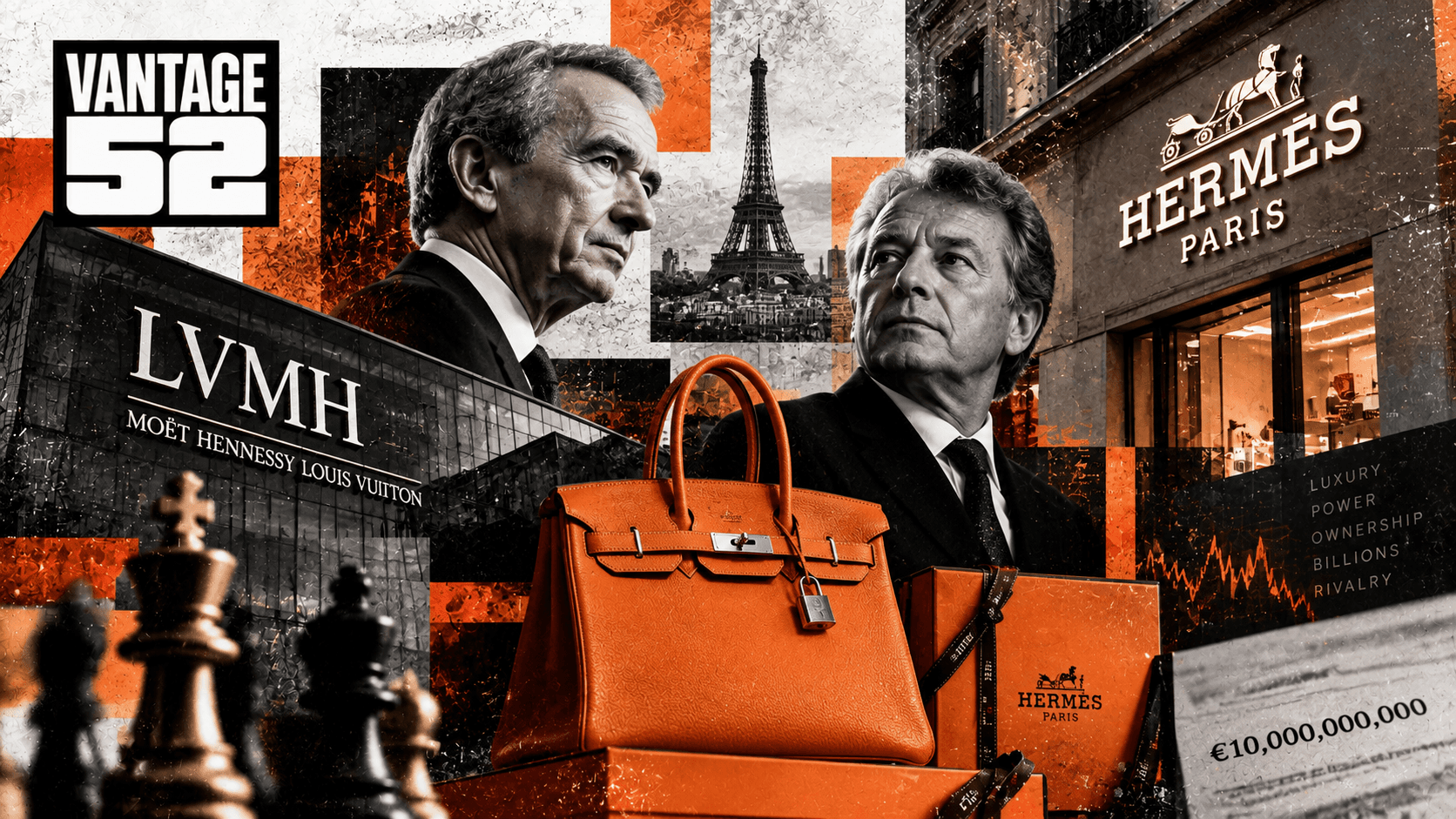
For more than two decades, the rivalry between LVMH and Hermès has been one of the defining battles of the luxury industry. Now, a previously undisclosed agreement from 2002 has reopened one of its most complicated chapters.
Documents reviewed by Reuters show that LVMH signed an agreement to purchase millions of Hermès shares from Nicolas Puech, a member of the founding family, and other heirs. The agreement was negotiated with Puech’s financial adviser Eric Freymond, who played a central role in LVMH’s efforts to accumulate shares in Hermès.
The revelation is significant because LVMH has previously denied efforts to acquire Puech’s shares against his wishes. Legal documents now show that LVMH had worked with Freymond on arrangements involving Hermès shares, while the company maintains that the 2002 agreement was never executed.
At the centre of the dispute is a fortune that has become extraordinarily valuable. Puech’s former 6% position in Hermès would be worth roughly $10 billion at current market prices, according to Reuters. Puech says he discovered in 2022 that his shares were no longer under his control after ending his relationship with Freymond. He subsequently sought €14 billion in damages.
The 2002 Agreement
According to documents reviewed by Reuters, the agreement was signed on November 12, 2002, between LVMH and Freymond in connection with the acquisition of millions of Hermès shares.
At the time, LVMH was quietly building its position in Hermès. The luxury conglomerate would eventually accumulate as much as 23% of the company before agreeing to distribute its stake to shareholders following a 2014 settlement.
The newly disclosed agreement is important because it places Puech’s shares inside the broader story of LVMH’s attempts to increase its exposure to Hermès.
LVMH has argued that the agreement was never executed because it could not establish whether Freymond had the authority to sell Puech’s shares. The company has also maintained that it never contemplated acquiring Puech’s stake against his wishes.
The existence of the agreement, however, adds another layer to a relationship that had previously been understood primarily through LVMH’s public accumulation of Hermès shares beginning in the 2010s.
The Fortune at the Centre of the Dispute
The financial scale of the case is what makes it particularly unusual.
Puech’s former 6% stake in Hermès is now worth approximately $10 billion, according to Reuters. The value reflects the extraordinary appreciation of Hermès over the past two decades and the scarcity of meaningful stakes in the family-controlled luxury group.
Puech says he discovered in 2022 that the shares were no longer under his control. His allegations focus on transactions involving Freymond, his former wealth manager and adviser.
The precise path taken by the shares remains disputed. It has not been established that LVMH ultimately acquired Puech’s shares through the 2002 arrangement, and the company denies that the agreement was completed. A French criminal investigation is examining the circumstances surrounding the disappearance of the stake.
That distinction is critical. The case involves serious allegations, but the final ownership history of the shares has not been conclusively established.
The Old Battle Between LVMH and Hermès
The dispute cannot be separated from one of the luxury industry's most closely watched corporate battles.
LVMH disclosed in 2010 that it had built a stake of more than 17% in Hermès, surprising the market and triggering a strong reaction from the Hermès family.
LVMH subsequently increased its position to approximately 23%. The Hermès family resisted the move and reinforced its own ownership structures. The confrontation eventually ended with a 2014 settlement under which LVMH distributed its Hermès shares to its own shareholders.
The newly revealed 2002 agreement adds an earlier chapter to that history.
It suggests that LVMH’s interest in Hermès was already being pursued years before the stake became public knowledge.
For the luxury sector, that makes the story less about a single legal dispute and more about the long-running tension between two fundamentally different corporate models: LVMH’s diversified luxury conglomerate and Hermès’ tightly controlled family business.
The Adviser Who Connected Two Worlds
Eric Freymond occupies a central position in the story.
He served as Puech’s financial adviser while also maintaining a relationship with LVMH. Reuters reports that LVMH and a company linked to Bernard Arnault’s family paid Freymond’s firm more than $20 million in commissions, management fees and advisory payments between 2001 and 2009.
LVMH has acknowledged its relationship with Freymond and his role in helping the company accumulate Hermès shares.
The relationship has attracted further scrutiny because Freymond was also closely connected to Puech.
Swiss lawyer Alexandre Montavon, who advised on the 2002 arrangement, has also been investigated in connection with the case. His lawyer has denied wrongdoing. Freymond died in Switzerland in July 2025 while the wider dispute was under investigation.
The overlapping relationships between Puech, Freymond and LVMH have therefore become a central feature of the legal proceedings.
Why Hermès Is Different
Hermès is not simply another publicly traded luxury company.
The company describes itself as an independent business backed by family shareholders, with its strategy built around craftsmanship, creation and a controlled distribution network.
Its ownership structure is equally important. According to Hermès’ official investor information, the Hermès family group maintains majority ownership of the company through family-controlled structures including Émile Hermès SAS, H51 and H2.
That structure has helped preserve Hermès’ independence while the company has grown into one of the world's most valuable luxury businesses.
Hermès reported €8.163 billion in revenue for the first half of 2026, with a restated net cash position of €12.926 billion and 27,107 employees at the end of June.
The company's financial strength makes any significant family stake extraordinarily valuable.
It also explains why control of Hermès has always been more than a question of share price. For the family, ownership is closely connected to the independence and long-term direction of the house.
A Luxury Fortune, a Corporate Rivalry and a Legal Battle
The case now brings together three different stories.
The first is a decades-old contest between two of the world's most powerful luxury groups.
The second is the extraordinary rise in the value of Hermès shares, transforming a family stake accumulated years ago into a multibillion-dollar fortune.
The third is the unresolved legal dispute surrounding Nicolas Puech and the people who managed his wealth.
LVMH says the 2002 agreement was never executed and denies acquiring Puech’s shares against his wishes. Puech maintains that he lost control of his Hermès fortune through transactions involving his former adviser. French authorities continue to investigate the circumstances.
What makes the story particularly significant is the way a document from 2002 has resurfaced more than two decades later, connecting a private family fortune to one of the most consequential ownership battles in modern luxury.
The episode also illustrates how concentrated ownership can transform a single block of shares into a question of corporate power, family control and billions of dollars in wealth. With Hermès still majority controlled by the founding family, and LVMH continuing to operate as the world's dominant luxury conglomerate, the old rivalry has acquired a new legal and financial dimension.
Tags
Key Concepts
Sources
Where the reporting above comes from. Follow these to check the figures and statements for yourself.