

America's $10 Trillion AI Infrastructure Boom Is Starting to Fray
The United States is preparing for an unprecedented expansion of artificial intelligence infrastructure, but project delays, rising financing costs and growing local resistance are testing the economics behind the boom. As investors demand clearer returns, the next phase of AI investment may depend as much on financial discipline as technological ambition.
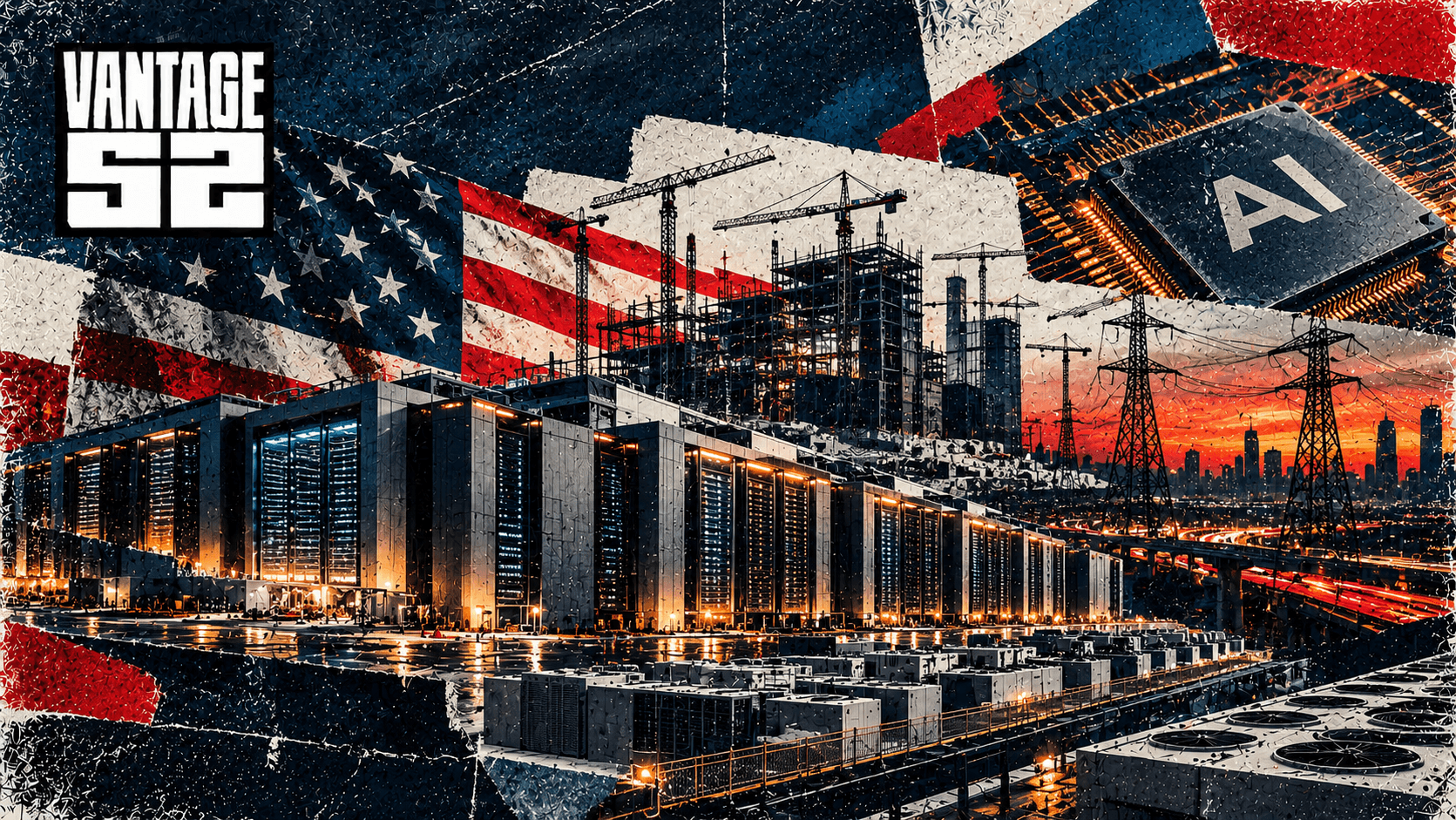
Artificial intelligence is driving one of the largest infrastructure investment cycles in modern American economic history. Data centres, advanced semiconductors, electricity generation and high-capacity computing networks are becoming essential components of the digital economy.
Estimates by Columbia Business School economist Stijn Van Nieuwerburgh, published through the Brookings Institution, suggest that investment in AI infrastructure could reach approximately $10.3 trillion between 2025 and 2032. The projection includes spending on data centres, power infrastructure and chips, equivalent to around 3.6 per cent of US gross domestic product annually.
The scale of the forecast reflects the industry's expectations for sustained demand. AI companies require increasingly powerful computing systems to train models, deliver services and support enterprise adoption. Technology groups are therefore committing enormous resources to infrastructure that they expect will underpin future revenue growth.
However, the construction effort is encountering a more complicated reality. Projects require land, electricity, equipment, financing and regulatory approval, often on timelines that are difficult to reconcile with the speed of technological development.
The question facing investors is shifting from how quickly AI infrastructure can be built to whether the industry can deliver enough economic value to justify the capital being committed.
Project Delays Challenge the Growth Narrative
The Financial Times reported on 18 October that at least 47 major US AI infrastructure projects had been delayed, withdrawn or blocked during 2026, citing data from regulatory intelligence company RegLayer. The report described this as a conservative estimate focused on large sites.
Analysts at Bernstein estimated that approximately 35 per cent of the planned US data centre pipeline was credible. The assessment points to a potential gap between announced capacity and projects with a realistic path to completion.
Infrastructure development is particularly vulnerable to delays because multiple elements must come together. A developer may secure a customer and financing while still facing obstacles involving permits, grid access, construction schedules or the availability of specialised equipment.
These challenges can create financial pressure across the project ecosystem. Delays increase costs, postpone revenue and potentially trigger contractual provisions that allow customers to withdraw if agreed delivery milestones are missed.
For AI companies, securing computing capacity remains strategically important. Yet infrastructure commitments become harder to justify when delivery dates move and the costs of completing projects rise.
The Financing Problem Behind the AI Boom
The industry's expansion increasingly depends on external capital. Alongside established technology companies, a new generation of specialised data centre operators, often described as neocloud providers, is financing large facilities to serve AI developers and enterprise customers.
These businesses can grow quickly when demand is strong, but their financial structures expose them to interest rates, debt-market conditions and the timing of future customer payments.
Reuters reported on 15 October that market volatility and rising borrowing costs were forcing companies involved in AI infrastructure to reconsider fundraising plans. Several proposed listings and financing initiatives had been paused or withdrawn as investors reassessed the risks associated with the sector.
CoreWeave illustrates the pressure facing infrastructure companies whose expansion requires substantial spending on computing hardware and data centre capacity. When debt becomes more expensive or investor confidence weakens, the cost of funding future projects can rise even if demand for AI services remains strong.
The issue extends beyond individual companies. If infrastructure providers struggle to raise capital, projects can be delayed across the supply chain, limiting the computing capacity available to AI developers.
This creates a potential mismatch between the industry's long-term growth expectations and its near-term ability to finance construction.
OpenAI, Anthropic and the Cost of Computing Power
Leading AI developers have strong incentives to secure computing capacity. Access to advanced chips and large-scale data centres can influence model development, product performance and the ability to serve customers at scale.
OpenAI and Anthropic are central to this demand. Their infrastructure commitments reflect expectations that AI adoption will continue expanding across software, business services and enterprise operations.
However, the economics of infrastructure depend on more than demand for computing power. Developers must also generate sufficient revenue to cover the costs of training, inference, hardware access and long-term capacity agreements.
Contracts can offer protection when infrastructure partners fail to meet financing or delivery requirements. Yet contractual flexibility cannot eliminate the broader risk of a project becoming more expensive or arriving later than expected.
The Financial Times report highlighted delays affecting several sites associated with OpenAI's Stargate initiative, alongside financing and delivery challenges involving other infrastructure developers. These developments illustrate how ambitious investment plans can encounter practical constraints even when the underlying technology has strong commercial momentum.
For AI companies, the strategic challenge is to balance speed with reliability. Securing capacity early may protect future growth, while excessive commitments can leave businesses exposed if demand, pricing or technology changes.
Electricity and Local Resistance Become Strategic Constraints
AI infrastructure depends on reliable electricity at a scale that many locations were not originally designed to support. Grid connections, energy availability and regulatory approvals are becoming central considerations in data centre development.
Local opposition is adding another layer of uncertainty. The Financial Times reported that more than 1,000 US communities had attempted to introduce moratoria or other restrictions on AI infrastructure during 2026.
Concerns surrounding electricity demand, land use and the local impact of large facilities can complicate planning decisions. Communities may question whether the economic benefits justify the pressure placed on public infrastructure and energy systems.
For developers, these issues affect location strategy, construction schedules and total project costs. Access to a suitable site is insufficient if the required power supply or regulatory permissions cannot be secured within the expected timeframe.
The constraints also have implications for the wider AI industry. Computing capacity depends on physical infrastructure, and physical infrastructure is subject to local conditions, engineering limitations and public policy.
As a result, electricity and permitting are becoming competitive factors alongside chips, software and model performance.
Investors Are Asking for Evidence of Returns
The AI infrastructure boom has been supported by expectations of sustained growth in demand for advanced computing. But the relationship between investment and future revenue remains central to the sector's valuation.
Building capacity ahead of demand can create a strategic advantage when adoption accelerates. It can also generate substantial financial exposure if utilisation rates fall short of expectations or if customers delay their commitments.
Higher borrowing costs make the calculation more demanding. Projects that appeared attractive under cheaper financing conditions may require stronger revenue assumptions to generate acceptable returns.
Investors are therefore examining the quality of customer contracts, the financial strength of infrastructure operators and the credibility of construction schedules. Announced investment totals alone provide limited insight into whether a project can be completed profitably.
The growing use of joint ventures, private credit and specialised financing structures also makes it important to understand where risk ultimately sits. The Brookings analysis of AI infrastructure financing highlights how capital requirements are spreading beyond the balance sheets of major technology companies.
The industry's next phase may reward businesses that can demonstrate disciplined capital allocation, credible execution and sustainable customer economics.
What the Infrastructure Reset Means for the AI Industry
A slowdown in selected projects would not necessarily signal the end of AI investment. Demand for computing capacity may continue to grow even as individual developers reconsider timelines, funding structures or locations.
A more selective investment environment could distinguish projects with secured power, committed customers and credible financing from proposals built primarily around optimistic assumptions.
Established technology companies may have advantages in accessing capital and managing large infrastructure programmes. Specialised operators can still play an important role, particularly where they offer efficient facilities, reliable delivery and differentiated access to computing resources.
Governments and local authorities will also influence the pace of development through energy policy, permitting and infrastructure planning. The challenge is to accommodate strategic investment while addressing the costs and concerns experienced by local communities.
For businesses adopting AI, infrastructure constraints may affect the price and availability of computing services. Companies that depend on large volumes of AI processing will need to consider capacity, vendor resilience and long-term cost structures as part of their technology strategy.
The broader lesson is that technological demand and financial sustainability are closely connected. AI can create significant economic opportunities, but those opportunities depend on infrastructure that can be financed, built and operated at viable cost.
The Next Test Is Economic Execution
America's AI infrastructure expansion remains a major strategic undertaking, with implications for productivity, technology leadership and competition in advanced computing. The projected scale of investment reflects how deeply AI has entered corporate and national economic planning.
Yet the sector is moving into a more demanding phase. Project delays, financing pressure, electricity constraints and community resistance are exposing the difference between announcing capacity and delivering it.
For investors, the central question is whether future cash flows can support the enormous capital commitments now being made. For AI companies, the challenge is to secure enough computing power without allowing infrastructure costs to undermine commercial performance.
The outcome will depend on execution as much as ambition. The companies best positioned for the next phase may be those that combine access to capital and technology with realistic timelines, reliable infrastructure and a clear path to returns.
The AI infrastructure boom is not defined by investment announcements alone. Its durability will ultimately be measured by the economic value that the infrastructure delivers.
Tags
Key Concepts
Sources
Where the reporting above comes from. Follow these to check the figures and statements for yourself.