
China Extends US Trade Truce to 10 January but Keeps Its 10% Tariff
Beijing’s 9 November notices keep the 24% tariff, rare earth export controls and port fees on US ships suspended into January. Washington matched on port fees, leaving importers, carriers and mineral buyers a two-month horizon.
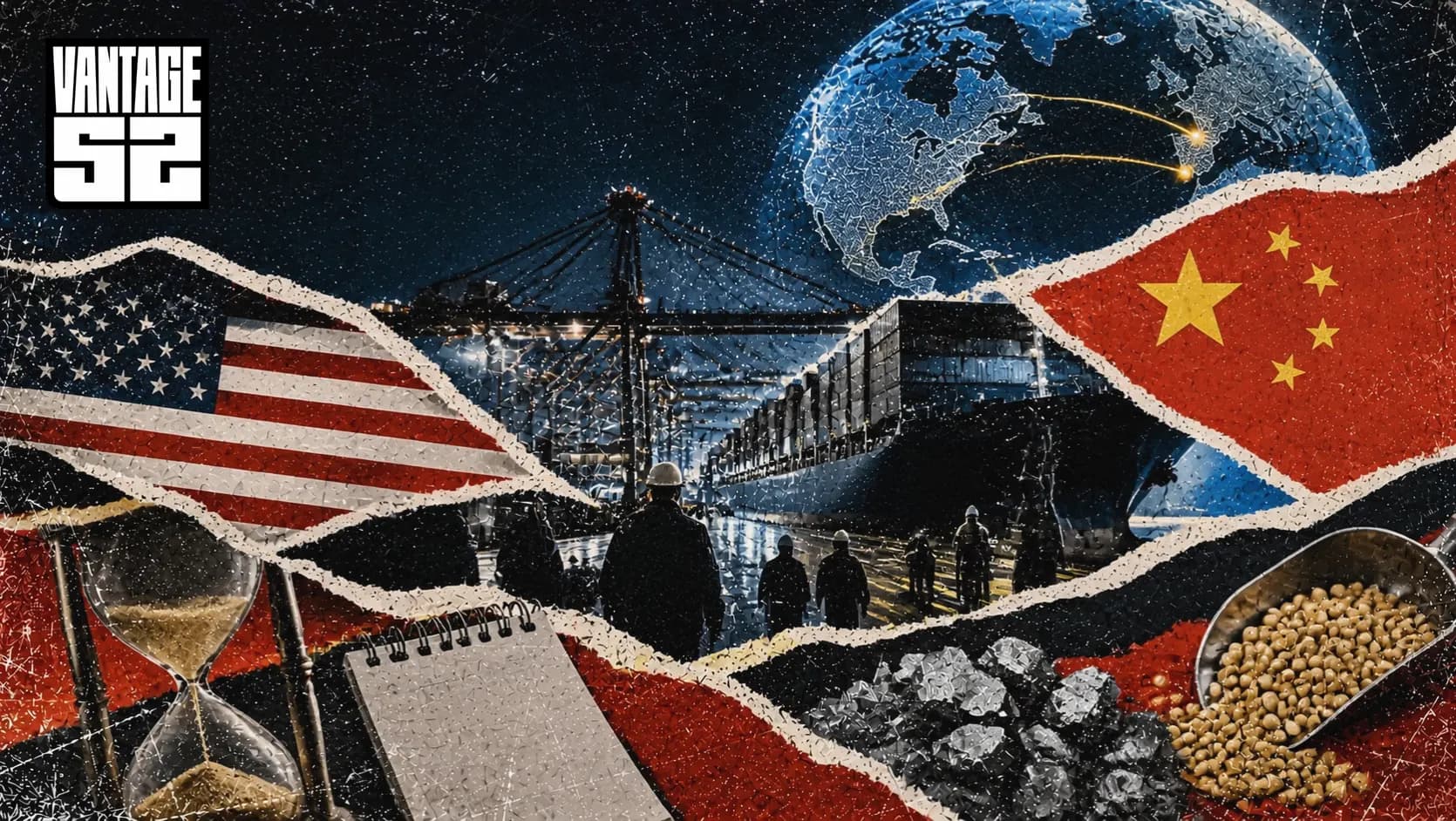
China extended its trade truce with the United States by two months on 9 November, a day before the measures were due to lapse. The State Council’s Customs Tariff Commission said the 24% additional tariff on US goods would remain suspended for two months from 1.01pm Beijing time on 10 November, while the 10% additional tariff stays in force.
The commerce and transport ministries carried the rest of Beijing’s suspended countermeasures to 10 January 2027, among them export controls on rare earths and lithium battery materials and special port fees on US-linked ships. Washington’s matching step took effect the same day, extending its own pause on port fees for China-linked vessels to 9 January.
The pauses agreed in Kuala Lumpur in October 2025 ran for a year. This one runs for two months, which leaves importers, shipowners and buyers of critical minerals with a planning horizon that ends in the second week of January. The APEC leaders’ meeting in Shenzhen on 18 and 19 November is the first chance to lengthen it.
Four Notices and One Tariff Left Standing
The tariff decision amends the commission’s Announcement No. 4 of 2025. According to Xinhua’s account published on the Chinese government portal, it implements “the outcomes and consensus reached at the meeting between the Chinese and U.S. heads of state in Washington”.
The Ministry of Commerce and the General Administration of Customs issued Announcement No. 58 of 2026, which keeps six export-control rules from October 2025 suspended from 11 November 2026 to 10 January 2027. They cover superhard materials, rare earth equipment and raw materials, five medium and heavy rare earths including holmium and europium, lithium batteries and graphite anode materials, foreign-made products containing Chinese rare earths, and rare earth technologies.
The ministry also extended by two months, from 10 November, its suspension of measures against 11 US entities placed on the unreliable entity list on 4 April 2025, and against 16 US entities added to its export control list that day. Chinese companies may apply to deal with the first group, and exporters may seek licences to ship dual-use items to the second. A separate ministerial order kept sanctions on five US subsidiaries of Hanwha Ocean, the South Korean shipbuilder, suspended for two months.
The Ministry of Transport, with State Council approval, suspended until 10 January its special port fees on US ships, the rules that implement them and its investigation into shipping and shipbuilding supply chains.
Washington Matched the Shipping Pause
The US Trade Representative’s notice in the Federal Register, published on 10 November, suspends the Section 301 fees on maritime transport services and the extra duties on Chinese ship-to-shore cranes and other cargo handling equipment from 9 November through 11.59pm Eastern Time on 9 January 2027. USTR received about 60 comments, some arguing that the fees were needed to spur investment in US shipbuilding.
The matching dates were agreed in advance. In a reading of the talks published on 28 September, China’s commerce ministry said negotiators meeting in New York and Washington from 20 to 23 September had agreed to extend the Kuala Lumpur arrangement, which paused measures on both sides until 10 November 2026, to 10 January 2027 while talks continue.
Scott Bessent, the US Treasury Secretary, announced the extension around the White House meeting between Donald Trump and Xi Jinping in late September. Reuters reported him saying it would give both sides “more time to see what we can do on the economic front.”
So the notices are China’s own legal acts, but the timetable is shared. That shapes how to read the 10% tariff that stays. It was Beijing’s response to US reciprocal tariffs imposed under the International Emergency Economic Powers Act, which US courts have since ruled invalid. The commission said it had noted Washington’s repeated statements that it intends to replace them with Section 301 tariffs, and that it would adjust its own countermeasures in light of US moves. Keeping the 10% gives Beijing something to trade away, or to raise, once that replacement takes shape.
Importers Face a 24-Point Overhang
For Chinese buyers of US goods, the extra duty today is 10%. If the suspension lapses, it becomes 34%. A cargo contracted in December for arrival after 10 January therefore carries a 24-percentage-point tariff risk that neither buyer nor seller can price with confidence.
The tariff cuts meant to build on the truce are also unfinished. Under the framework the commerce ministry described in September, each side is to cut tariffs on about $30 billion of goods from the other, with about 90% of those products falling to most-favoured-nation rates once domestic procedures are complete. Reuters described the package as worth $60 billion, including roughly $17 billion of US farm goods that China imported in 2024.
Asked about farm purchases on 12 November, a commerce ministry spokesperson said the two sides were in close communication on implementing the cuts and urged Washington to help bring them into effect soon. Until then, US agricultural exporters sell into China at the 10% rate with the 24-point overhang.
Ships and Cranes on the Same Deadline
Shipping faces the cleanest version of the problem. Both countries’ port fees now return on the same weekend unless extended again, so rotations scheduled for January have to be costed against two regimes. Charter parties and service contracts that pass port fees through to cargo owners will decide who carries that risk.
Importers who placed orders at the 140th Canton Fair in Guangzhou, which closed on 4 November, may see some of those goods cross the Pacific as the window closes. Whether ships linked to China pay US fees on arrival after 9 January is a negotiating point, not a settled cost, and some US commenters have asked USTR to treat the crane duties separately.
Critical Minerals Run on Two Clocks
The rare earth suspension now runs to 10 January, but a second pause expires sooner. Under Announcement No. 72 of 2025, the commerce ministry suspended until 27 November 2026 the clause of a December 2024 rule that in principle barred exports of gallium, germanium, antimony and superhard materials to the United States and imposed stricter end-use checks on graphite. That clause was not among the notices issued on 9 November.
The rule’s first clause, which bans dual-use exports to US military users, stays in force, and gallium and germanium still need export licences under rules dating from 2023. For US electronics and chip manufacturers that buy Chinese gallium and germanium, the date that matters is 27 November, eight days after the Shenzhen summit, not 10 January.
From Shenzhen to Miami to 10 January
Xi and Trump are expected to meet at the APEC summit in Shenzhen, Reuters reported, which would be their third meeting this year. After the Washington summit, both governments said each leader intends to attend the summit the other hosts, which puts the G20 in Miami on 14 and 15 December on the same calendar.
The September agreement also fixed smaller dates. The commerce ministry said the two sides would hold their next dialogue on artificial intelligence before the end of November and the first meeting of a new agricultural working group before the end of 2026.
In its September reading, the ministry said it expected the two sides to find a positive solution on a further extension through high-level contacts before the year ends. The open question is the length. A return to a one-year pause would let companies sign 2027 contracts on known terms. Another two months would confirm that both capitals prefer to keep each other on short deadlines, with Washington’s Section 301 replacement for the voided tariffs, and Beijing’s promised response, as the next real test.
Tags
Key Concepts
Sources
Where the reporting above comes from. Follow these to check the figures and statements for yourself.
- Gov.cn (Xinhua), China extends suspension of 24 pct additional tariff on U.S. goods for two months The Customs Tariff Commission decision, its effective time, the retained 10% tariff and its comments on Section 301 and IEEPA.
- Ministry of Commerce and General Administration of Customs, Announcement No. 58 of 2026 on continuing to suspend six export-control announcements Suspension of the October 2025 controls on rare earths, lithium battery materials and superhard materials from 11 November 2026 to 10 January 2027 (in Chinese).
- Ministry of Commerce, Spokesperson on adjusting unreliable entity list measures Two-month suspension of measures on 11 US entities listed on 4 April 2025 (in Chinese).
- Guangming Online, Ministry of Transport continues to suspend special port fees on US ships Republication of the Transport Ministry notice suspending port fees and the shipbuilding investigation until 10 January 2027 (in Chinese).
- Office of the US Trade Representative, Notice of modification of Section 301 action on China’s maritime, logistics and shipbuilding sectors Federal Register notice suspending US port fees and cargo handling equipment duties through 9 January 2027.
- Ministry of Commerce, Department of American and Oceanian Affairs reading of the eighth round of China-US consultations The agreed extension to 10 January 2027, the $30 billion reciprocal tariff framework, coal, the agricultural working group and the AI dialogue (in Chinese).
- Ministry of Commerce, Regular press conference of 12 November 2026 The spokesperson’s comments on implementing the reciprocal tariff cuts and on relations before APEC (in Chinese).
- Beijing Daily, Ministry of Commerce Announcement No. 72 of 2025 suspending the second clause of its 2024 US export-control rule Full text of the suspension to 27 November 2026 and of the 2024 rule on gallium, germanium, antimony, superhard materials and graphite (in Chinese).
- gCaptain (Reuters), China Extends US Trade Truce by Two Months Reuters report on the full package, the Hanwha Ocean units, the $60 billion tariff-cut plan, Scott Bessent’s comments and the expected APEC meeting.
- Herald Business, US and China extend trade truce by two months as talks shift to APEC and G20 Dates of the APEC summit in Shenzhen and the G20 in Miami, and both leaders’ stated intention to attend.