

Tesla Moves Beyond Batteries With Powercore, a Solid-State Transformer Due in 2027
Unveiled at RE+ in Las Vegas on 17 November, the 7.4 megawatt unit targets storage, solar and AI data centres. Tesla named no price or customers, and its energy revenue fell 16% last quarter.
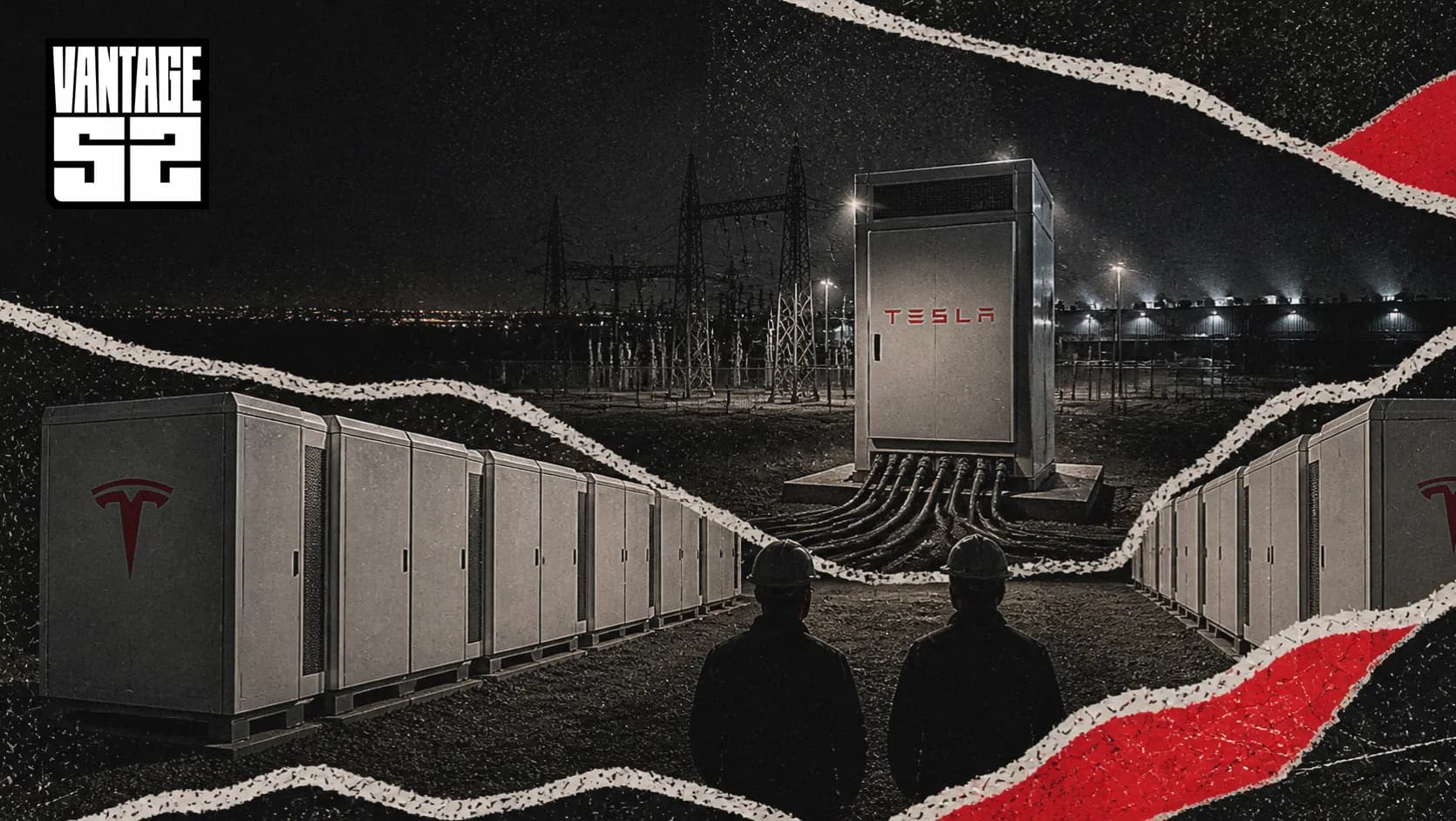
Tesla unveiled Powercore at the RE+ energy trade show in Las Vegas on 17 November, a single cabinet that combines a solid-state medium-voltage transformer, an inverter and a circuit breaker. Tesla’s Megapack account on X rated it at 7.4 megawatts, or 9 megavolt-amperes, continuously at 34.5 kilovolts, with grid-forming support for 10 megavolt-amperes of peak power. The post ended “Made in America. Operating 2027.”
It is an announcement, not a product in service. Tesla gave specifications and a 2027 operating date to pv magazine USA, which had the first interview, but disclosed no price, no customers and no production start date.
The launch takes Tesla’s energy business from storing electricity into the equipment that connects it to the grid. That market is short of supply, with Wood Mackenzie estimating a 15% shortfall in power transformers this year, and it is held by suppliers such as Siemens, ABB, Eaton and Schneider Electric.
Three Pieces of Grid Equipment in One Cabinet
Tesla’s pitch, as pv magazine reported it, is to replace the separate transformers, inverters and switchgear that sit between a solar farm or battery site and the grid with one unit of power electronics. Powercore takes direct current at 800 to 2,000 volts and delivers alternating current at 10 to 34.5 kilovolts. It is rated to work from minus 40C to 55C and carries a warranty of up to 25 years.
Its built-in solid-state breaker clears faults in 100 microseconds, which pv magazine described as an industry first. AJ Booth, Tesla’s head of energy and charging, framed the safety case in the company’s terms.
We think we’re safer because we can interrupt faults a thousand times faster than traditional equipment.
AJ Booth, Tesla, to pv magazine USA
That is Tesla’s claim, made before any unit is in service. Booth also pointed to scale. “We’ve done 3 terawatts of power converters at Tesla,” he said, adding that the company builds all of its power converters in-house.
Storage First, Then Data Centres
The first market is Tesla’s own. Powercore connects to Megapack batteries through DC bus connectors, and the two can arrive pre-assembled to cut wiring and labour on site. Tesla already bundles conventional grid gear with its batteries. Megablock, unveiled at the same show in September 2025, combines four Megapack 3 units with an integrated transformer and switchgear in a 20 megawatt-hour block, with deliveries due from the second half of 2026, ESS News reported at the time. Powercore goes a step further by swapping the conventional transformer for power electronics of Tesla’s own.
For solar, it accepts high-voltage direct current straight from the panels, supporting existing 1,500-volt plants and emerging 2,000-volt designs.
Data centres are the larger ambition. Powercore can convert medium-voltage grid power to 800 volts of direct current for server racks in a single step, the level used in NVIDIA’s reference rack designs. Tesla says it is working with NVIDIA on 800-volt architectures, and ESS News reported that Tesla is seeking to qualify Powercore under NVIDIA’s DSX Ready programme, in which Megapack 2XL was one of only three battery systems qualified as of September. Booth argued that a data centre paired with Powercore and Megapack would get a stiffer, more stable local grid.
The pitch is aimed where power has become the constraint. Electricity demand from data centres keeps rising even as AI gets cheaper to run, and Musk himself warned at a G20 meeting in September that power supply could fall short of AI demand.
What Tesla Energy Earns Now
Powercore arrives as Tesla’s energy revenue is falling. Tesla’s third-quarter 10-Q reports energy generation and storage revenue of $2.881 billion, down 16% from $3.415 billion a year earlier, and $8.428 billion for nine months, down 6%. Tesla attributes the fall to tariff refunds owed to some Megapack customers, a lower average selling price per Megapack, fewer Powerwall installations and fewer solar retrofits, partly offset by more Megapack deployments.
The business is small but profitable. Its gross profit was $954 million in the quarter, a margin of 33.1%, against 18.5% for Tesla’s car business. Energy brought in about 10% of Tesla’s revenue and about 17% of its gross profit, by VANTAGE52’s calculation from the filing.
Part of that margin was one-off. After a ruling on tariffs imposed under the International Emergency Economic Powers Act, Tesla booked $526 million of refunds against energy costs in the quarter and cut energy revenue by $339 million for refunds it owes customers, a net gain of about $187 million.
The forward indicators are stronger than the revenue line. Tesla deployed 13.7 gigawatt-hours of storage in the third quarter and 36.0 gigawatt-hours in the first nine months, and a new Megafactory near Houston began production in the quarter. Contracted energy revenue not yet recognised on contracts longer than a year stood at $10.73 billion on 30 September, of which Tesla expects $4.80 billion within 12 months. Customer prepayments held as deferred revenue rose to $3.30 billion from $2.04 billion at the end of 2025. Musk said on the third-quarter earnings call that Megapack production was nearly sold out for 2027, according to Not a Tesla App.
A Crowded Race to Replace the Transformer
Wood Mackenzie estimated on 31 August that power transformers face a 15% shortage in 2026 and substations 8%, and that more than $22 billion of bulk-power equipment imported since 2025 came almost entirely from China. Executive Order 14420 now bans such imports from certain countries, chiefly China, with the Department of Energy given 120 days to implement it. Wood Mackenzie said it is unclear how the order’s bulk-power definition applies to data-centre loads. pv magazine has reported lead times of up to four years for transformers.
A US-made unit fits that gap on paper, but Tesla is not alone in trying to fill it. The incumbents are chasing the same customers. Siemens, which competes with Schneider Electric, ABB and Eaton in that equipment, now gets around a fifth of its Smart Infrastructure revenue from data centres. Eaton completed its purchase of Resilient Power Systems, a solid-state transformer maker, in August 2025 to speed such units into data centres and energy storage.
The closest rival has Tesla roots. Heron Power, founded by Drew Baglino, who spent nearly two decades at Tesla leading its powertrain and energy groups, raised $140 million in February to build solid-state transformers for data centres, solar and storage, TechCrunch reported. Its 5 megawatt units convert medium voltage to 800 volts for NVIDIA’s reference racks, with pilot production planned for early 2027, the same year Tesla says Powercore will be operating.
The Order Book That Will Decide It
So far Tesla has shown a specification sheet and a year. The commercial tests come next, a first named customer, a price set against conventional transformers and switchgear, and NVIDIA’s qualification for data-centre use.
The nearer number is Tesla’s fourth-quarter deployment figure, due in early January. It will show whether the storage business Powercore is built to serve is growing again after a quarter in which Megapack deployments rose and revenue fell.
Tags
Key Concepts
Sources
Where the reporting above comes from. Follow these to check the figures and statements for yourself.
- Tesla Megapack, Post on X introducing Powercore Tesla’s announcement with the 7.4 megawatt rating and the 2027 operating date, quoted in full by Not a Tesla App.
- Tesla, Form 10-Q for the quarter ended 30 September 2026 Energy segment revenue, gross profit, tariff refunds, deployments, contracted revenue and customer prepayments.
- Tesla, Third quarter 2026 production, deliveries and deployments Tesla’s release filed with the SEC, giving 13.7 gigawatt-hours of storage deployed in the quarter.
- pv magazine USA, Tesla unveils Powercore medium-voltage power electronics platform at RE+ 2026 The first interview, with specifications, applications and AJ Booth’s comments.
- ESS News, Tesla unveils Powercore medium-voltage power electronics platform NVIDIA DSX Ready qualification status and the absence of a production start date.
- Not a Tesla App, Tesla unveils Powercore, a new 7.4 MW solid-state transformer coming in 2027 The full text of Tesla’s X post and Musk’s earnings call comment on Megapack demand for 2027.
- Wood Mackenzie, US executive order banning Chinese bulk-power equipment set to worsen critical transformer shortage Estimated 2026 shortages of power transformers and substations, import figures and the scope of Executive Order 14420.
- TechCrunch, Heron Power raises $140M to ramp production of grid-altering tech Heron Power’s funding, its founder’s Tesla background, its product and its 2027 production plan.
- Electrical Review, Eaton completes acquisition of Resilient Power Systems Eaton’s purchase of a solid-state transformer maker aimed at data centres and energy storage.
- ESS News, Tesla unveils new generation of utility-scale batteries, Megapack 3 and Megablock Megablock’s integrated transformer and switchgear and its delivery timetable.