

Tesla’s $29,990 Cybercab Will Not Run Without a $299 Monthly Subscription
Tesla began inviting select buyers on 13 November to order its two-seat car with no steering wheel, for use only inside its Robotaxi zones. Musk says the fee should be about $115. The terms still say $299.
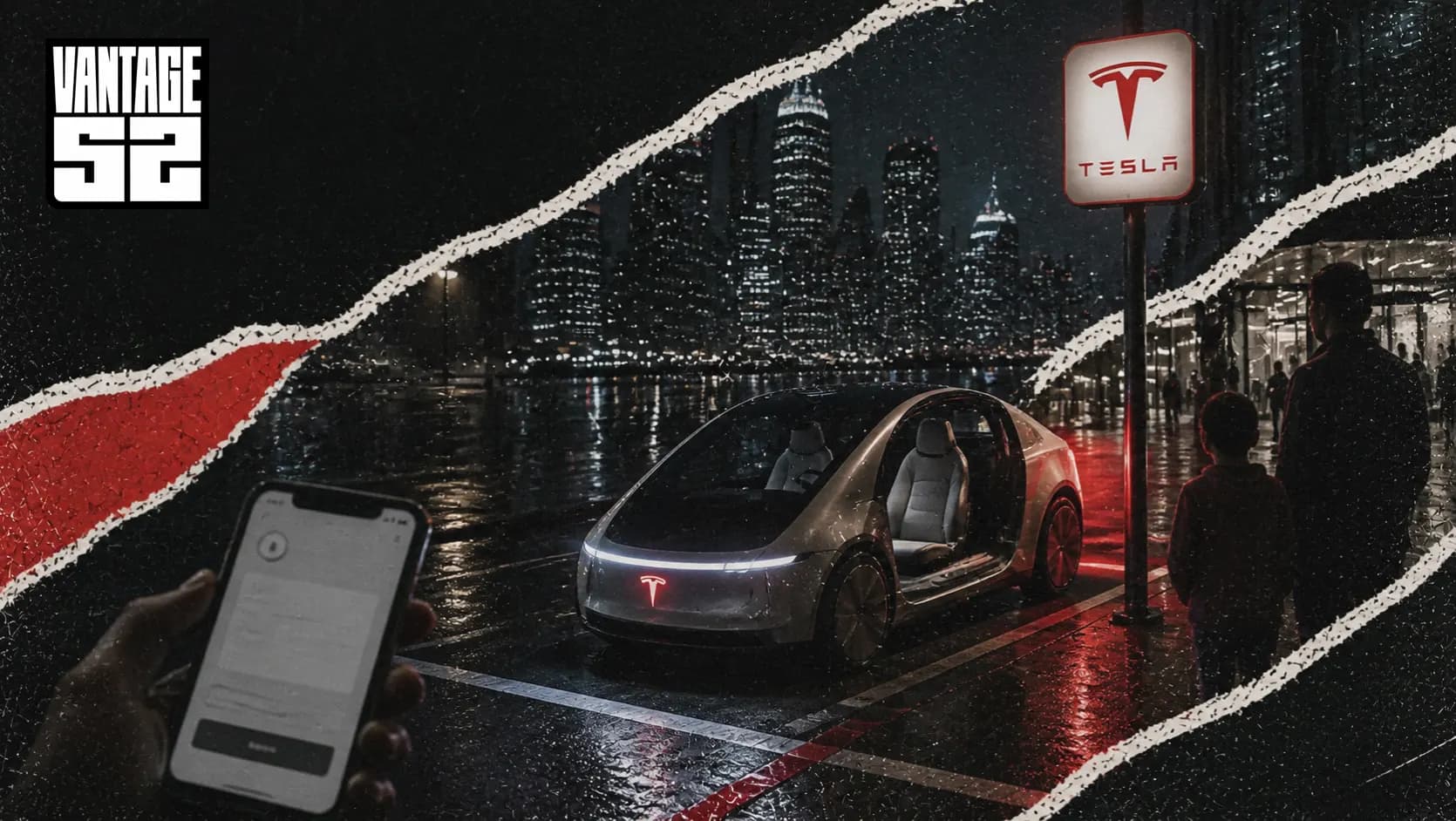
Tesla began inviting select customers on 13 November to order the Cybercab, its two-seat car with no steering wheel or pedals, for personal use. The order page, reproduced by Electrek and Not a Tesla App from screenshots that Tesla’s Robotaxi account posted on X, lists the car at $29,990 before taxes, with a $1,000 non-refundable deposit and estimated delivery in Austin, Texas, in December 2026.
The price buys the car but not the right to use it. A $299-a-month Autonomy Subscription is pre-selected on the page with the first month included, and the fine print reads “Subscription and regular vehicle maintenance required to operate.” Tesla’s Cybercab Autonomy Subscription Agreement, version 20261112, which Electrek quoted on 14 November, puts it more plainly. “Your Cybercab will not operate without an active Autonomy Subscription.”
On 14 November Elon Musk, Tesla’s chief executive, posted on X that the monthly fee was too high and “should match the cost of Tesla FSD and connectivity for other models, which is more like ~$115/month.” That is his view of what the price ought to be, not a change to it. Reports through 18 November, including EVwire and CarScoops, still gave the order terms as $299 a month, and none reported a revised order page. Tesla’s website refused automated access when VANTAGE52 tried to check it on 20 November.
What Tesla has put on sale is a subscription with a car attached. The car runs only where Tesla allows, only while the fee is paid, and the fee is one Tesla can change at a month’s notice.
What the Order Terms Say
Beyond the price, the invitation email, the order page and the agreement, as reported by Electrek and Drive Tesla Canada, set out who controls the car after delivery.
- Operation is “Only available in supported service areas”, and Tesla “may expand, reduce, relocate, or otherwise modify the operating area at any time.”
- Tesla can change the subscription price with one month’s notice.
- The car is for personal use only. It may not join Tesla’s Robotaxi network, Uber, delivery apps or rental platforms without Tesla’s written approval.
- Three or more strikeouts for improper or unsafe use bring a one-week suspension of autonomous driving, and payments are not prorated.
- Tesla can remotely locate, restrict or control the car, or place it in a “safe state”.
- Owners may not sell or transfer the car without Tesla’s written permission, on pain of damages of at least $50,000 or the full value of the transaction if higher, and Tesla can buy it back at a fair market value it sets, Drive Tesla Canada reported.
Not a Tesla App and EVwire reported that the eligible areas are Tesla’s Robotaxi zones in five Texas cities, Austin, Dallas, Fort Worth, Houston and San Antonio.
Even inside those cities the usable area is smaller than the map suggests. Electrek cited Koby Pierce, an independent tracker, who found that pickup and drop-off zones covered 59% to 78% of the advertised geofences in the six cities he checked, and about 59% in Austin.
Musk’s $115 Is a Post, Not a Price
Musk was replying to Marques Brownlee, the technology reviewer, who had posted a breakdown of the order page, according to EVwire. In the same reply Musk wrote that the Cybercab “will be available nationwide, as we receive regulatory approval.” He gave no date for a lower fee or for wider sales.
His comparison is not like for like. Not a Tesla App lists FSD (Supervised), the driver assistance subscription for Tesla’s other cars, at $99 a month and Premium Connectivity at $9.99, close to his figure. Drive Tesla Canada reported that the Cybercab fee also covers roadside assistance and some maintenance items, among them tyres, the windscreen, wipers and cabin filters. Tesla has not said what a $115 fee would include.
The contract cuts both ways. The clause that lets Tesla reprice the subscription with a month’s notice would let it adopt Musk’s figure without a new agreement. It would equally let it raise the fee.
Five Years of Payments
With the first month included, five years of ownership carry 59 paid months. At $299 that adds $17,641 to the $29,990 price, a total of $47,631 before insurance, registration, charging and taxes, the figure Electrek calculated. At $115 the subscription would add $6,785, for a total of $36,775.
At the current fee, five years of subscription cost 59% of the purchase price. Musk had promised a Cybercab below $30,000 when Tesla unveiled it in 2024, and $29,990 keeps that promise for the hardware alone. CarScoops noted that the price undercuts the cheapest Model 3.
The recurring payment is the point for Tesla. Its third-quarter 10-Q credits higher revenue from FSD (Supervised) subscriptions with supporting car sales revenue, and puts deferred revenue tied to connectivity, FSD features, free Supercharging and software updates at $4.08 billion on 30 September, up from $3.87 billion at the end of 2025. In a letter to shareholders filed with the SEC on 18 November, Tesla’s board claims 1.74 million paid FSD customers worldwide and an attach rate of about 75% on new North American deliveries in the third quarter.
For buyers of Tesla’s other cars, FSD is optional. For a Cybercab owner it is not, which makes every unit sold a paying subscriber from the day of delivery.
Where Regulators Come In
Musk’s nationwide claim depends on approvals Tesla does not yet have. Autonomous services in other industries are also expanding at the pace of rule-makers, as Zipline’s drone delivery network, still waiting on a federal flight rule, shows. And with no single federal AI law, companies face a mix of agency and state rules that differ from place to place.
The nearer question is federal safety certification. Under a special order in docket AQ26002, the National Highway Traffic Safety Administration required Tesla to show under oath that the Cybercab meets federal motor vehicle safety standards, after Tesla began charging for Cybercab rides in Austin on 3 September, Electrek reported. NHTSA asked how a car with no foot brake meets a standard requiring service brakes to be worked by a foot control, and how the Cybercab operates without a Part 555 exemption. Such exemptions are capped at 2,500 vehicles a year, and Tesla certified the car itself instead.
Tesla filed its answers on 30 October with a one-page letter stating that “The entirety of this file is confidential business information.” As of 5 November, Electrek reported, NHTSA had neither ruled on that request nor found the Cybercab out of compliance with any standard. The agency’s opening summary put the vehicles covered at about 1,000.
Until now those vehicles ran in Tesla’s own fleet, which its 10-Q says began adding Cybercabs in September. Private sales would put cars whose certification is under federal review in the hands of individual owners.
The Month That Decides the Fee
Tesla’s estimate puts the first private deliveries in December. If the order terms hold, those owners pay nothing for the first month and $299 from the second, unless Tesla gives notice of a new price before then. Musk’s post is so far the only public signal that it might.
The other decision belongs to NHTSA. Its chief counsel rules under the agency’s Part 512 procedure on whether Tesla’s sworn answers stay sealed, and can order a public version released. Either outcome will tell private buyers more about how their car was certified than the order page does.
Tags
Sources
Where the reporting above comes from. Follow these to check the figures and statements for yourself.
- Tesla, Form 10-Q for the quarter ended 30 September 2026 Cybercab rollout in September 2026, FSD subscription revenue and deferred revenue for connectivity and FSD features.
- Tesla, Additional proxy materials with the board’s response to ISS and Glass Lewis The board’s claims of 1.74 million paid FSD customers and a 75% North American attach rate.
- Elon Musk, Post on X on the Cybercab subscription fee Musk’s statements that the fee is too high and that the Cybercab will be available nationwide as approvals arrive, quoted by EVwire and Not a Tesla App.
- Electrek, Tesla Cybercab orders open at $29,990 plus $299 a month, only in Robotaxi zones The order page, invitation email, fine print, five-year cost and the geofence coverage data.
- Electrek, Tesla Cybercab’s autonomy agreement terms Quotations from the Cybercab Autonomy Subscription Agreement, version 20261112.
- Drive Tesla Canada, Tesla Cybercab purchase agreement reveals strict ownership and operating restrictions Resale restrictions, the $50,000 damages clause, the buyback right and what the subscription covers.
- Not a Tesla App, Musk says Cybercab sales are going nationwide and the $299 subscription is too high Musk’s post, the Texas service areas and current FSD and connectivity prices.
- EVwire, Tesla Cybercab on sale with a $299 Autonomy Subscription as Musk says it should be about $115 The full text of Musk’s reply to Marques Brownlee and confirmation that the price had not changed.
- Electrek, Tesla wants its sworn Cybercab answers to NHTSA kept entirely secret NHTSA’s special order in docket AQ26002, Tesla’s confidentiality request and the status of the review.
- CarScoops, Tesla opens Cybercab orders to private buyers Report on 18 November still giving the order terms as $299 a month with one month’s notice of price changes.