
Trump, Xi and Silicon Valley Are Redrawing the Global AI Map
The White House meeting between Donald Trump and Xi Jinping has placed artificial intelligence at the center of the U.S.-China relationship, while the presence of Silicon Valley’s most powerful technology executives has underscored how deeply AI has become tied to global economics, national security and geopolitical power.
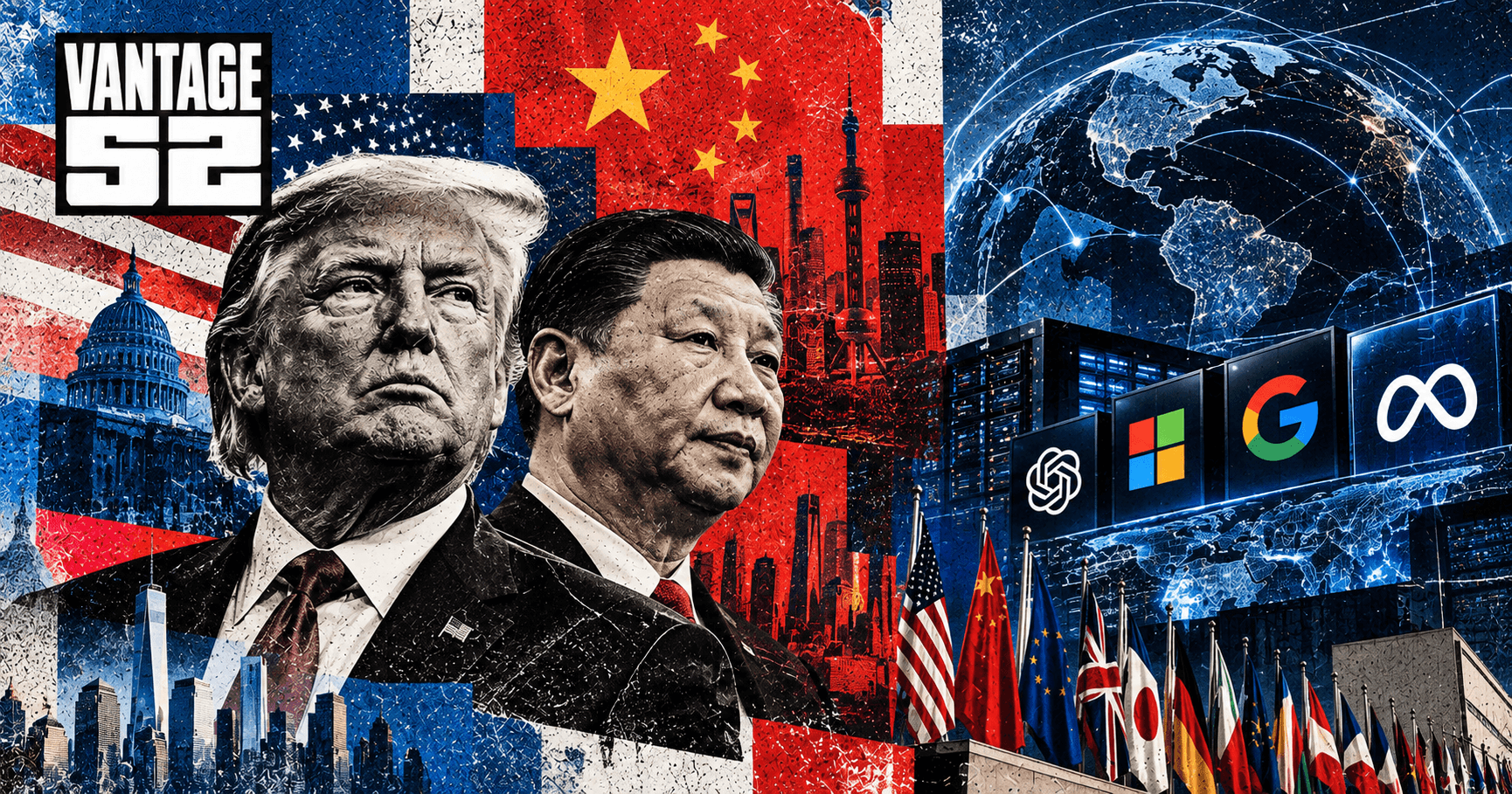
When Donald Trump welcomed Xi Jinping to Washington on Thursday, the meeting was formally about the relationship between the world's two largest economies. Trade, rare earth minerals, Taiwan and broader security issues were all part of the agenda. Yet artificial intelligence occupied an increasingly important position in the discussions, reflecting a reality that has become difficult for governments to ignore: the future of AI is now inseparable from the future of U.S.-China relations.
Trump had already elevated the language around AI earlier in the week at the United Nations, where he said U.S. government documents should refer to artificial intelligence as “super intelligence.” Ahead of his meeting with Xi, Trump said that “Super Intelligence” would be a major topic of discussion and indicated that he did not want to impose new limits on its development.
Xi approached the subject differently. During the White House meeting, the Chinese president emphasized that AI development should remain under human control and said that the United States and China should cooperate on managing both the benefits and risks associated with the technology. China's official account of the meeting said Xi called for continued dialogue on AI risks and benefits and cooperation to prevent misuse and abuse.
The contrast is significant because both countries are simultaneously competing for technological leadership and discussing mechanisms that could prevent AI-related risks from destabilizing the relationship.
AI Has Moved Into the Center of U.S.-China Relations
For much of the past decade, the U.S.-China technology rivalry was defined primarily by semiconductors, telecommunications infrastructure and access to advanced computing.
AI has now brought those issues together.
The world's most capable AI systems depend on advanced chips, enormous data-center capacity, electricity, cloud infrastructure and highly specialized engineering talent. Control over those resources increasingly determines how quickly companies and countries can develop and deploy new models.
That makes AI policy inseparable from industrial policy.
The United States has imposed restrictions on the export of certain advanced chips and semiconductor technologies to China, while Chinese companies and research institutions have continued investing heavily in domestic AI capabilities. At the same time, both governments recognize that an uncontrolled technological confrontation could create risks neither side can manage independently.
The result is an unusual combination of competition and interdependence.
The CEOs Who Sat at the Table
The symbolism became even more visible during the White House state dinner.
Among the technology leaders present were Nvidia CEO Jensen Huang, AMD CEO Lisa Su, Apple executive chairman Tim Cook and Tesla CEO Elon Musk. Other major technology figures, including OpenAI CEO Sam Altman, Amazon founder Jeff Bezos, Alphabet CEO Sundar Pichai and Dell CEO Michael Dell, were also included in the wider guest list.
The presence of these executives was more than ceremonial.
Their companies sit at different points in the technology chain that underpins the AI economy. Nvidia and AMD are deeply connected to the semiconductor infrastructure required to train and operate advanced models. Apple depends heavily on Chinese manufacturing and remains deeply connected to the Chinese consumer market. Tesla operates a major manufacturing and commercial business in China. OpenAI and Google are directly involved in developing advanced AI systems.
Together, these companies illustrate the complexity of the relationship between Washington and Beijing.
The United States may view China as its principal strategic competitor in advanced technology, while many American technology companies continue to have substantial commercial interests in the Chinese market.
Silicon Valley Has Its Own China Equation
The dinner therefore brought together two different versions of the AI race.
Washington is concerned with national security, technological advantage and supply-chain resilience. Silicon Valley is also thinking about those issues, but its companies must simultaneously consider customers, manufacturing, revenue, investment and access to global markets.
MarketWatch noted before the dinner that Tesla generated nearly $21 billion in revenue from China in 2025, while Apple generated more than $64 billion from its Greater China region. Nvidia, meanwhile, has faced restrictions and regulatory complications surrounding the sale of advanced AI processors into China.
Those numbers demonstrate why the relationship cannot be reduced to a simple technology rivalry.
For American companies, China is simultaneously a market, manufacturing base, regulatory environment and strategic competitor.
For Washington, that creates a difficult policy equation. Restrictions designed to protect U.S. technological advantages can also affect the commercial interests of American companies whose global businesses depend on China.
From Chips to Superintelligence
Trump's decision to use “super intelligence” as an alternative term for AI adds another dimension to the debate.
In technical AI research, superintelligence generally refers to a hypothetical level of machine intelligence that would substantially exceed human capabilities across a broad range of cognitive tasks. It is therefore not simply another name for today's artificial intelligence systems.
Trump's use of the term is primarily political and rhetorical, but it reflects the increasingly ambitious way Washington is describing the technology.
At the United Nations, Trump argued that the United States should encourage rather than restrain AI development. He also rejected attempts to establish a global regulatory framework for AI.
Xi's position in Washington placed greater emphasis on human control and international cooperation.
That difference could become increasingly important as AI systems become more autonomous and capable of performing tasks without direct human intervention.
Washington and Beijing Are Beginning to Build an AI Dialogue
Despite their differences, the two governments have also started creating mechanisms for communication.
Ahead of the Trump-Xi meeting, U.S. Treasury Secretary Scott Bessent said Washington and Beijing had agreed to establish a bilateral AI dialogue. The proposed mechanism is intended to create a channel for discussing AI risks, national-security concerns and possible incidents involving advanced systems.
That development matters because the two countries do not need to agree on every aspect of AI policy to recognize that some risks are shared.
An AI system that creates a cybersecurity incident, interacts with critical infrastructure or behaves unpredictably could generate consequences that cross national borders.
A communication channel could therefore become an important part of managing competition even while the underlying technology race continues.
The Infrastructure Behind the Race
The most consequential part of the AI rivalry may ultimately be less visible than the models themselves.
AI requires enormous amounts of computing power. That means semiconductor manufacturing, advanced processors, data centers, electricity generation, networking equipment and cloud infrastructure have all become strategic assets.
This is why companies such as Nvidia, AMD, Microsoft, Amazon, Google and other infrastructure providers are increasingly important to the geopolitical AI debate.
The technology race is no longer simply about who has the smartest model. It is also about who can build enough infrastructure to train, deploy and continuously improve those models.
That makes the AI economy closely connected to energy, industrial policy and capital markets.
A New Type of Technology Diplomacy
The Trump-Xi meeting illustrates how technology diplomacy is changing.
In previous decades, heads of state could discuss trade and security while leaving most technology negotiations to government ministries and corporate executives.
AI makes that separation increasingly difficult.
The CEOs attending the White House dinner represent companies whose products and infrastructure directly influence the strategic balance between the world's two largest economies. Their presence demonstrates how technology companies have become participants in geopolitical discussions that were once dominated by diplomats and defense officials.
The boundary between corporate strategy and national strategy is becoming increasingly blurred.
The Global AI Map Is Being Redrawn
The significance of the Trump-Xi meeting therefore extends beyond a single summit or dinner.
The United States and China remain competitors in artificial intelligence, but they also have incentives to maintain communication over a technology that could reshape economic growth, national security and global power.
For Silicon Valley, the challenge is even more complicated. Technology companies must navigate a world in which the same markets that create enormous commercial opportunities can also sit at the center of geopolitical competition.
The dinner at the White House offered a powerful visual representation of that new reality. Trump and Xi represented the world's two largest powers, while Huang, Su, Cook, Musk, Altman, Pichai and other technology leaders represented companies building the infrastructure and applications of the next technological era.
The global AI map is no longer being shaped only in research laboratories. It is being shaped in boardrooms, semiconductor factories, data centers, government offices and diplomatic meetings.
The meeting between Trump and Xi showed that artificial intelligence has moved firmly into that arena, where technology, capital and geopolitics are increasingly becoming parts of the same strategic equation.
Tags
Key Concepts
Sources
Where the reporting above comes from. Follow these to check the figures and statements for yourself.
- South China Morning Post - Xi-Trump dinner puts US tech titans in spotlight
- The Washington Post - Xi acknowledges risks of AI even as Trump dismisses them
- Los Angeles Times - Xi urges human control over AI at White House summit
- Financial Times - OpenAI joins call for US-led global AI standards
- Financial Times - US-China establish AI dialogue ahead of Trump-Xi meeting
- MarketWatch - What Musk, Huang and Cook’s companies want from China
- Associated Press - Trump and Xi see tensions flare over AI, trade and Iran
- White House - Details of Xi Jinping’s 2026 State Visit