

Apple Just Bet $1,999 On The Future Of The iPhone
A foldable at twice the price of a Pro, and the first product judgement of the Ternus era.
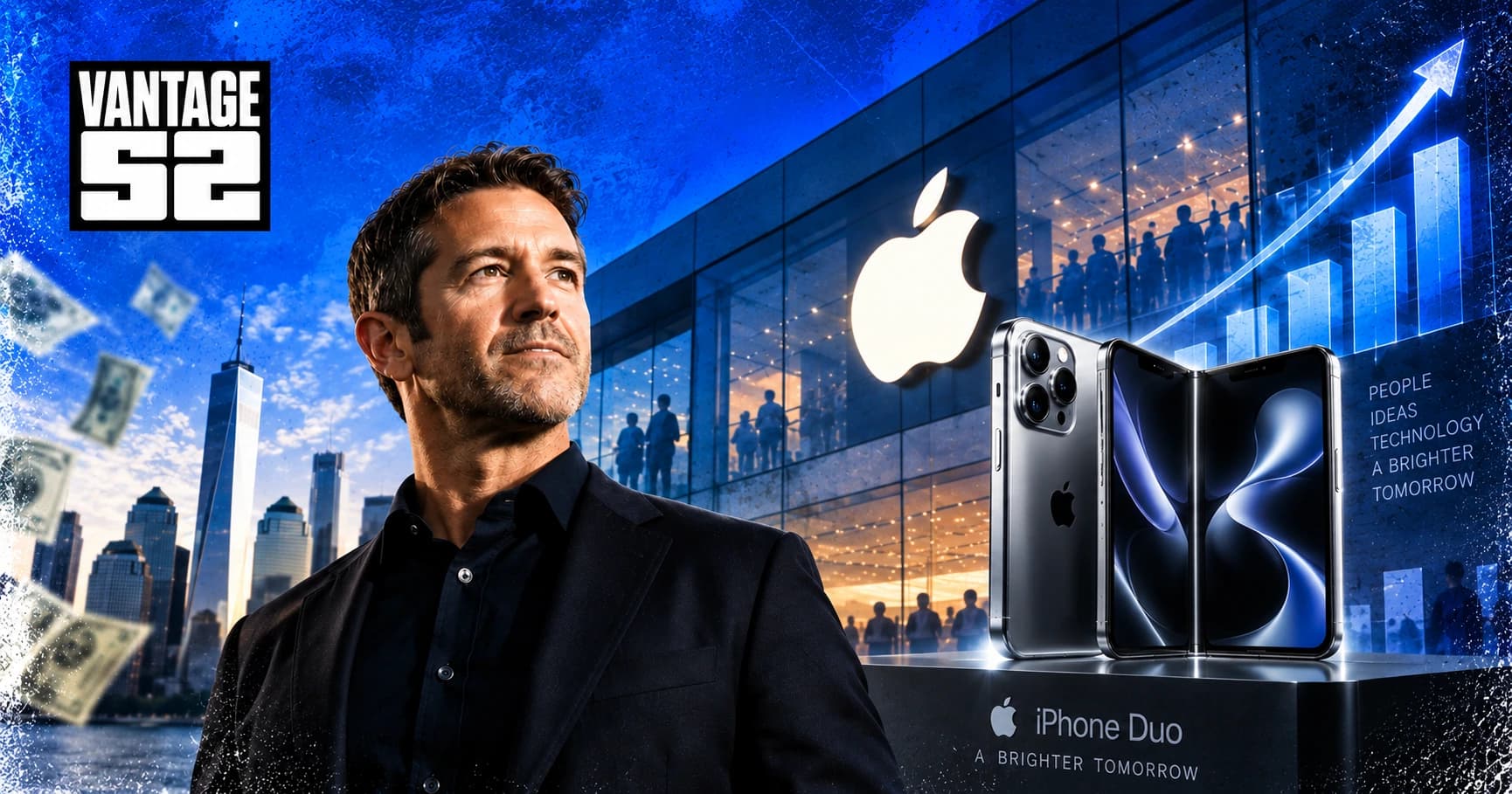
Apple has made its biggest bet on the future of the iPhone in years.
On September 9, the company unveiled iPhone Duo, its first foldable iPhone, introducing a new form factor at a starting price of $1,999. The launch also marked the first major product event under CEO John Ternus, making the announcement as much about Apple's next chapter as it is about a new device.
The iPhone Duo opens into a 7.6-inch display and closes around a 5.4-inch outer screen. Apple says the device is its thinnest iPhone when opened and is built around a titanium structure, a precision hinge and a dual-battery architecture. Preorders begin October 16, with availability starting October 23.
The price immediately changes the conversation.
At $1,999, iPhone Duo enters a market where foldable smartphones have largely remained a premium niche. Samsung, Huawei, Google and other manufacturers have spent years developing the category, but adoption has remained relatively small. Apple is entering later, with the advantage of seeing where competitors succeeded and where consumers resisted.
That delay may be one of Apple's biggest strategic advantages.
Why Is Apple Entering The Foldable Market Now?
The conventional smartphone market has matured. Consumers are keeping devices for longer, annual upgrades have become harder to stimulate and the physical design of the smartphone has changed relatively little over the past several years.
Apple's answer is to create a new premium upgrade cycle.
A foldable iPhone gives existing customers something fundamentally different to buy while preserving the ecosystem that has made the iPhone Apple's most important consumer product. The company can introduce a new physical category without asking customers to leave iOS, the App Store, iCloud or the broader Apple ecosystem.
That distinction matters.
Apple is not trying to invent the foldable smartphone category. It is trying to make the category commercially meaningful at Apple's scale.
What Makes The iPhone Duo Different?
The hardware is designed around two distinct modes of use.
Closed, the 5.4-inch outer display keeps the device compact. Opened, the 7.6-inch screen creates a larger workspace for multitasking, gaming and content consumption. Apple has also introduced Split View, allowing two applications to run side by side, while users can open two windows of the same application.
That makes the product strategically interesting beyond its physical design.
Apple is positioning the foldable iPhone as a productivity device as much as a smartphone. The larger screen allows the company to move the iPhone closer to the territory traditionally occupied by smaller tablets and mobile computers, potentially increasing the amount of time users spend inside Apple's ecosystem.
The company is also bringing Apple Pencil support to the device later this year, further expanding its potential use cases.
Can Apple Justify A $1,999 iPhone?
This is where the business case becomes more complicated.
Apple has spent years pushing its premium products higher in the market. The iPhone 18 Pro starts at $1,199, while the Pro Max starts at $1,299. iPhone Duo therefore sits in an entirely different pricing tier.
The company is betting that a meaningful group of customers will pay almost twice the price of a conventional premium smartphone for a fundamentally different experience.
That could have an important effect on Apple's average selling price.
If the product succeeds, Apple gains another premium tier without having to increase prices across its entire iPhone range. The foldable becomes an additional revenue opportunity rather than a replacement for the existing portfolio.
What Does The Launch Mean For Apple's AI Strategy?
AI is becoming increasingly central to Apple's hardware strategy.
The iPhone Duo is powered by Apple's A20 Pro chip and includes the next generation of Apple Intelligence and Siri AI. Apple says its AI architecture combines on-device processing with Private Cloud Compute, allowing more demanding workloads to use cloud infrastructure while maintaining its privacy-focused approach.
This is important because Apple is taking a different route through the AI market.
Rather than positioning AI as an independent destination, Apple is embedding it across the operating system and hardware. Siri AI can use personal context, understand what is displayed on the screen and interact with information across applications.
The larger foldable display gives those capabilities more room to operate.
In that sense, the iPhone Duo is both a hardware experiment and an AI interface experiment.
Why Does John Ternus Matter?
The leadership transition adds another layer to the launch.
John Ternus is presenting Apple's next product direction after Tim Cook's long tenure as CEO. His background is heavily rooted in hardware engineering, making the arrival of a completely new iPhone form factor particularly significant.
Cook built Apple's modern business around operational scale, global supply chains, services and an increasingly broad hardware ecosystem.
Ternus now inherits that machine at a moment when Apple faces a different set of challenges.
AI is changing the technology industry. Smartphone growth is becoming harder to sustain. Competitors are experimenting with new hardware formats. At the same time, Apple must continue convincing consumers that upgrading to the next iPhone is worth the cost.
The foldable iPhone gives Ternus an immediate opportunity to demonstrate what his Apple looks like.
Could Apple Change The Foldable Market?
Apple's entry could be more important for the category than the company's initial sales.
Foldable smartphones have existed for years, but they have struggled to move from premium curiosity to mainstream consumer category. Apple is entering a market still led by established foldable manufacturers, and analysts expect the company's participation to accelerate adoption.
Apple has a unique ability to reshape categories through its ecosystem.
The company controls hardware design, software, application distribution, retail, services and marketing. If developers begin designing more applications around Apple's foldable interface, the value of the category could expand rapidly.
That would create a feedback loop.
More users would attract more developers. More applications would make the hardware more useful. Greater utility could justify the premium price.
What Is Apple Really Selling?
The most interesting part of iPhone Duo may have little to do with its hinge.
Apple is selling a new reason to upgrade.
For years, the smartphone industry has competed around better cameras, faster processors, brighter displays and longer battery life. Those improvements remain important, but they increasingly produce smaller differences between generations.
A foldable changes the physical relationship between the user and the device.
That gives Apple something rare in a mature market, which is a new product narrative.
The company is therefore taking a calculated risk. It is entering a category late, charging a significant premium and asking consumers to change how they use the most important device in their daily lives.
If that works, the $1,999 price tag may look less like a gamble and more like the opening price of Apple's next major product category.
Apple's September 9 event was therefore about more than a foldable iPhone.
It was the first major signal of how John Ternus intends to lead Apple, how the company sees the future of the smartphone and how aggressively it intends to turn AI into part of the everyday computing experience.
The question now is simple.
Will iPhone Duo become Apple's most expensive iPhone, or the product that defines its next era?
Tags
Key Concepts
Sources
Where the reporting above comes from. Follow these to check the figures and statements for yourself.