

Elon Musk Says AI Could Surpass Humanity's Combined Intelligence Within Five Years
Machine intelligence passing the human total, with robots and electricity setting the pace.
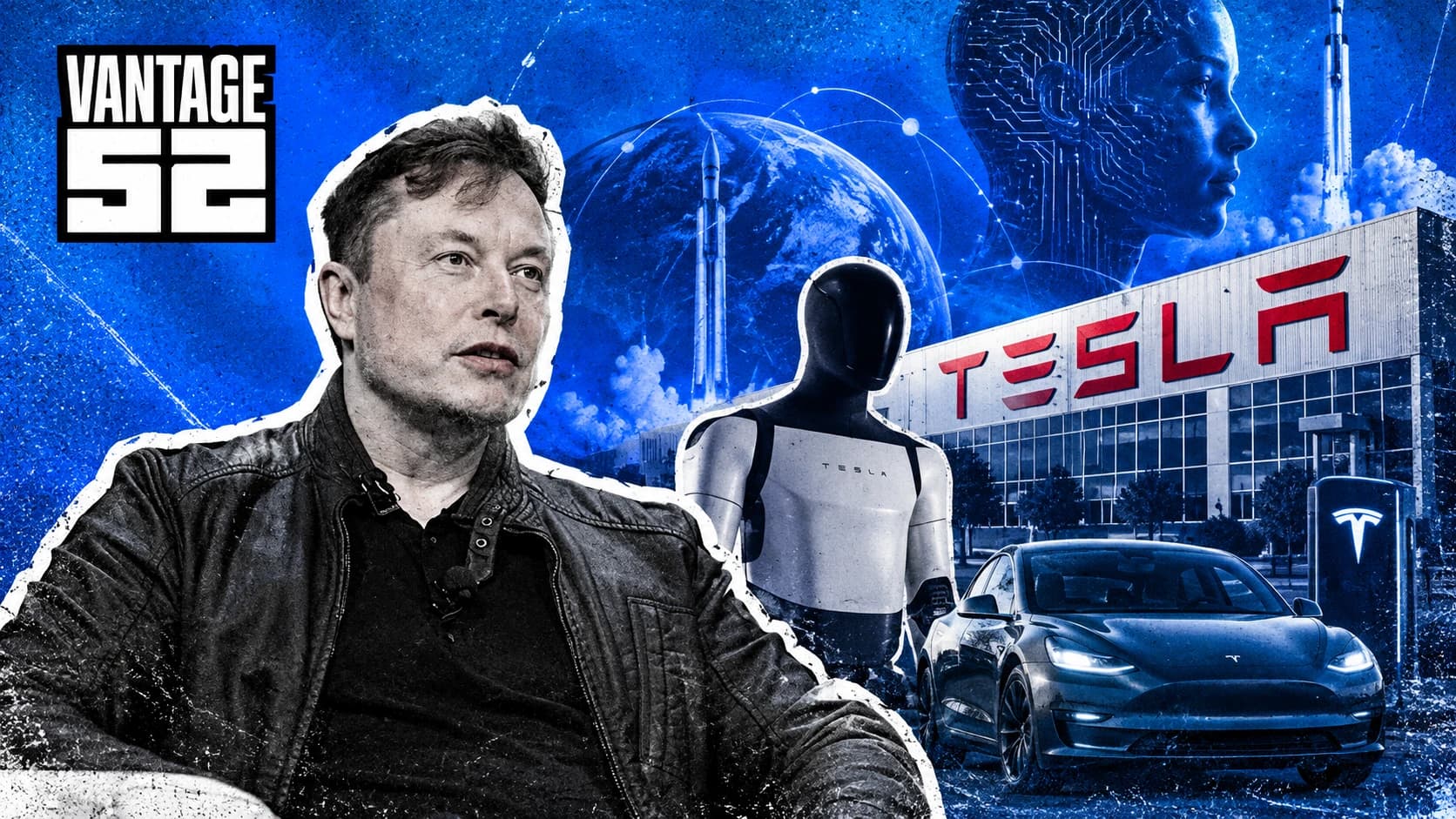
Artificial intelligence is moving from a technology story into an economic and organisational question, and Elon Musk believes the pace of that transformation could be far faster than most institutions are prepared for.
In a recent interview with The Economist, Musk argued that artificial intelligence could exceed the combined intelligence of humanity within roughly five years. His prediction extends beyond the familiar debate over whether AI will outperform people in individual tasks. Musk is describing a future in which machine intelligence could become greater than the collective intellectual capacity of humans, fundamentally changing how economies, companies and work itself are organised.
The statement builds on a prediction Musk made earlier in 2026 at the World Economic Forum in Davos, where he said AI could become smarter than any individual human by the end of the year and potentially surpass humanity's collective intelligence within five years. The latest comments place that prediction within a broader argument about productivity, robotics, energy and the future structure of the economy.
What Would It Mean For Intelligence To Exceed Humanity?
Musk's argument is based on the speed at which digital intelligence can improve and replicate. Human intelligence develops through biological processes and generations of learning, while AI systems can be trained, copied and deployed across large computing infrastructures.
That distinction becomes more significant as AI moves from specialised software into systems capable of performing increasingly broad categories of intellectual work. Musk told The Economist that he expects a future in which there may be very few digital tasks that AI cannot perform better than humans, while the physical world will remain constrained by robotics, manufacturing capacity and the availability of energy.
The distinction between digital and physical intelligence is central to Musk's broader thesis. Software can be replicated relatively quickly, whereas physical machines require factories, components, supply chains and energy infrastructure. His expectation is that the gap between the two will narrow as humanoid robots become increasingly capable.
Why Does Musk Connect AI With Humanoid Robots?
For Musk, artificial intelligence becomes economically transformative when it gains a physical form.
Speaking at the G20 Innovation Ministerial Summit in North Carolina on September 1, Musk argued that humanoid robots could eventually create a recursive manufacturing cycle in which robots help manufacture additional robots. He estimated that there could be more than one billion humanoid robots within ten years, with each producing roughly five times the output of a human worker.
Such a scenario would represent a fundamental change in productive capacity. If machines could perform physical tasks at scale while AI systems handle increasingly sophisticated digital work, the traditional relationship between labour, productivity and economic output would begin to change.
Musk suggested that the combined productivity of those robots could eventually exceed the output of all humans. His estimate remains a forecast rather than an established economic projection, yet its significance lies in the scale of the transformation he is describing.
Could AI Reshape The Global Economy?
Musk estimates that AI could eventually increase global economic output by between 20 and 30 percent. He expects physical AI and humanoid robotics to push that impact much further, potentially increasing economic output by an order of magnitude.
The economic mechanism behind this expectation is straightforward. If software can automate a growing share of knowledge work while robots expand the amount of physical production that can be performed without human labour, companies could potentially produce more goods and services with fewer constraints from labour availability.
That possibility raises a much broader question about how economic value will be distributed.
Higher productivity can create greater output, but productivity gains also change the economics of employment, wages, investment and consumption. If machines perform an increasing share of productive activity, businesses and governments may have to reconsider how purchasing power reaches consumers and how the benefits of technological progress are distributed across society.
Musk has described a future in which work could eventually become optional as AI and robotics generate an abundance of goods and services. That idea remains highly speculative, but it represents one of the most consequential implications of his forecast.
Where Does Energy Fit Into The AI Race?
Electricity is becoming another constraint on the expansion of AI, and Musk considers it increasingly significant.
At the G20 meeting, he argued that AI development could face an electricity shortage as demand for data centres and advanced computing infrastructure grows. He pointed to a mismatch between the rapid expansion of AI chips and the much slower growth of electricity supply in many regions.
This creates an important distinction between technological capability and technological deployment. An AI model can exist as software, but operating increasingly powerful systems at global scale requires enormous amounts of computing infrastructure, data centres and electricity.
Musk therefore sees energy production as part of the AI competition itself. Countries seeking to attract AI infrastructure may increasingly compete through access to electricity, data-centre capacity and the broader industrial systems required to support large-scale computing.
The issue is already becoming part of the international policy debate. At the G20 technology meeting, Musk argued that countries should develop new energy sources outside China to support future AI data-centre demand, while also criticising what he considers excessive technology regulation in the European Union.
What Happens To Work In An AI-Driven Economy?
The labour market may ultimately become the most disruptive part of Musk's prediction.
If AI reaches a point where it can perform most digital tasks more effectively than humans, the value of many knowledge-based roles could change rapidly. Software development, analysis, administration, customer service, research and other cognitive occupations could experience significant restructuring as businesses integrate increasingly capable AI systems.
The transition, however, is unlikely to occur uniformly. Physical industries require robotics, manufacturing infrastructure and supply chains, while highly regulated professions involve legal, institutional and social constraints that technology alone cannot remove.
Musk's own distinction between digital and physical work reflects this difference. He expects digital capabilities to advance considerably faster because software can be replicated across computing systems, whereas physical automation requires machines to be produced and deployed at scale.
For businesses, this means the question is shifting from whether AI will influence work to which parts of the organisation will change first.
Companies may increasingly redesign roles around AI-assisted productivity, reduce repetitive processes, restructure teams and place greater value on areas where human judgement, relationships, creativity and responsibility remain difficult to automate.
What Does Musk's Prediction Mean For Companies?
The corporate implications may arrive long before AI surpasses humanity's collective intelligence.
Businesses are already assessing how AI can reduce operating costs, accelerate product development, analyse information and improve customer experiences. As models become more capable, the strategic advantage may increasingly belong to organisations that understand how to redesign their operating systems around AI rather than treating it as another software tool.
This could affect everything from workforce planning and technology investment to organisational design and capital allocation.
For executives, the challenge is therefore less about predicting the exact date when AI becomes superintelligent and more about understanding how quickly their own industry's economics could change.
An organisation whose competitive advantage depends heavily on routine knowledge work may face a very different future from a business built around physical production, specialised expertise or human relationships. The speed of AI adoption could also vary significantly between countries depending on energy infrastructure, regulation, investment capital and access to advanced computing.
A Prediction That Reaches Beyond Technology
Musk's five-year forecast should be understood as a prediction rather than a certainty. The development of AI depends on technical progress, computing capacity, energy availability, capital investment, regulation and the ability to translate increasingly capable models into reliable real-world systems.
Yet the significance of his comments extends beyond whether the forecast proves accurate.
The more fundamental question is what happens when intelligence becomes abundant.
For more than a century, economic growth has been closely connected to the ability of human beings to acquire skills, organise labour and develop increasingly productive machines. AI introduces a different possibility, in which machines improve their ability to perform intellectual tasks while also helping create the physical systems required for further automation.
That possibility explains why the AI discussion has moved rapidly from technology departments into boardrooms, financial markets and government policy.
Musk's prediction may prove too aggressive, or developments may move even faster than expected. Either way, the direction of the debate is becoming clear. Artificial intelligence is increasingly being evaluated not simply as a new category of software, but as a potential transformation of productivity, labour, capital and the structure of the global economy.
Tags
Key Concepts
Sources
Where the reporting above comes from. Follow these to check the figures and statements for yourself.