

Europe Wants Bigger Companies. Is Scale Becoming A New Competitive Advantage?
Brussels is rethinking whether size is a problem to police or a capability to build.
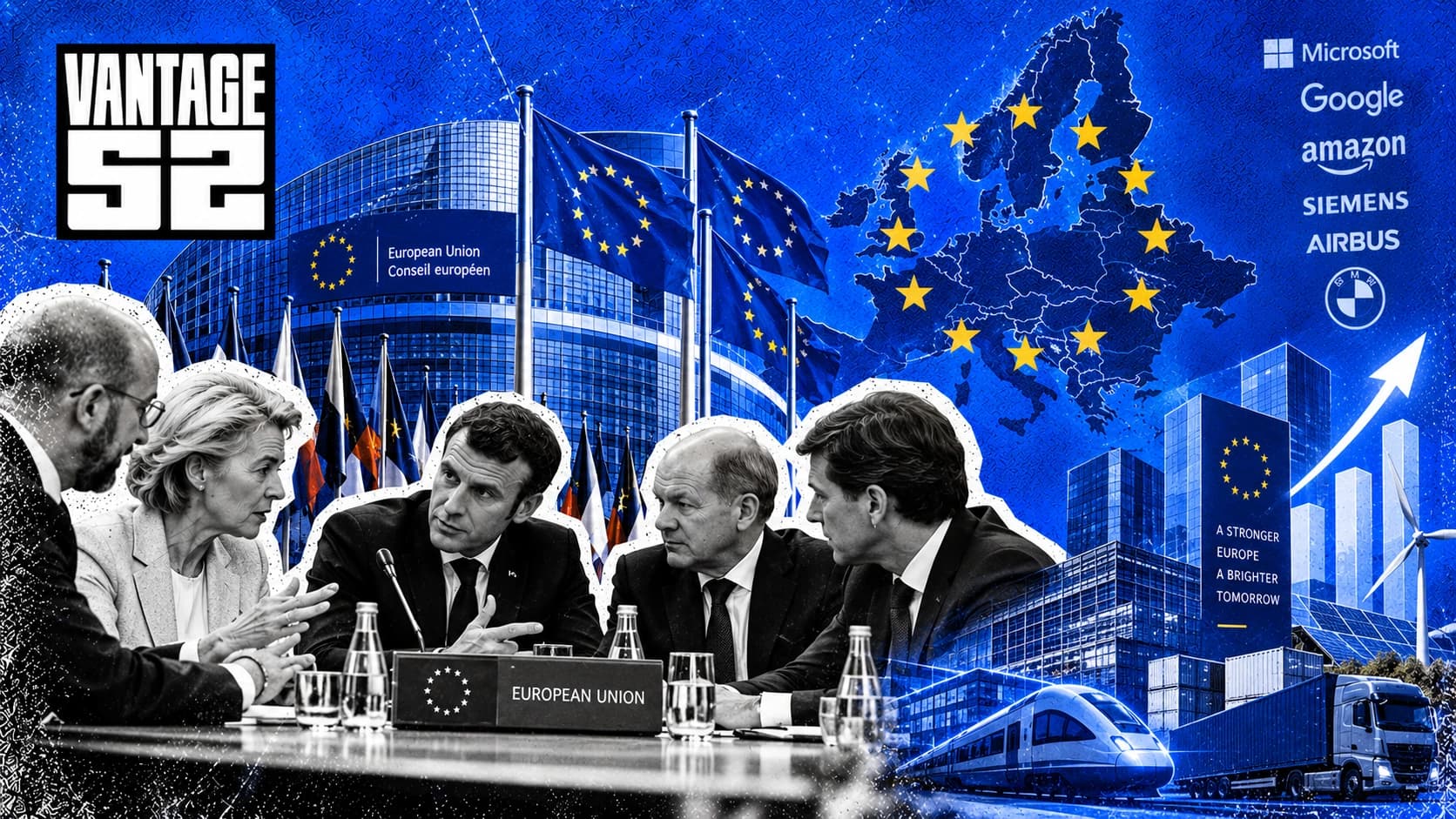
For years, Europe has approached corporate concentration with a question that has shaped some of the world's strictest competition policies. How large can a company become before its size starts working against the market?
That question is beginning to change.
On September 8, a senior European Commission competition official signalled greater openness toward large corporate mergers that could strengthen investment, innovation and supply security. The argument is increasingly connected to a broader concern about Europe's ability to compete with companies from the United States and China.
The shift points to a larger strategic question for European business.
In a global economy where technology, capital and infrastructure increasingly reward scale, can European companies remain competitive without becoming significantly larger?
Why Is Europe Reconsidering The Value Of Scale?
Europe has no shortage of established companies. Its challenge is that many operate across a fragmented market, while some of the world's most powerful technology and industrial companies have reached a scale that allows them to invest billions in infrastructure, research and expansion.
Artificial intelligence has made the issue more visible.
Building competitive AI infrastructure requires enormous amounts of computing capacity, energy and capital. The European Commission itself describes the shortage of large-scale computing infrastructure as a major obstacle to Europe's ability to compete globally and has placed AI gigafactories at the centre of its strategy.
Scale therefore has a different meaning in sectors where the cost of reaching the next technological frontier is measured in billions.
A company that is too small may struggle to finance the infrastructure required to compete, even if its underlying technology is strong.
Is Bigger Automatically Better?
The answer is more complicated.
Large companies can spread research and development costs across bigger revenue bases. They can negotiate stronger supply agreements, finance major infrastructure projects and enter new markets with greater resources.
Mergers can accelerate that process.
The European Commission's revised approach does not mean that every large merger will receive approval. Competition authorities remain responsible for preventing transactions that reduce competition, increase market power or harm consumers. The Commission's merger framework continues to focus on whether transactions preserve effective competition.
What is changing is the weight given to factors such as scale, resilience, investment and innovation.
The Commission's ongoing review of its merger guidelines is the broadest such review in roughly two decades. Its draft framework explicitly considers positive effects associated with scale, investment, resilience and innovation.
That represents a meaningful change in the strategic environment.
Why Does This Matter For European Companies?
For European businesses, the issue extends beyond mergers and acquisitions.
It concerns the ability to build companies capable of competing globally.
A large American technology company can finance enormous research programmes, acquire emerging technologies and build global infrastructure from a position of significant scale. Chinese companies benefit from enormous domestic markets and extensive industrial ecosystems.
European companies often operate within a different structure.
The Single Market provides a large economic area, yet regulatory, linguistic, financial and national differences can still make expansion more complex than the market's headline size suggests.
That fragmentation can affect how quickly companies scale.
A European startup may have strong technology and a viable product but face a different commercial environment as it expands from one member state to another. A mature industrial company may have global ambitions but remain constrained by national markets, capital structures or supply dependencies.
Scale can therefore become a strategic asset long before it becomes a financial one.
Could Mergers Become Part Of Europe's Industrial Strategy?
This is where the latest signal becomes particularly significant.
The European Commission's competition leadership has argued that competition policy and industrial policy can reinforce each other. Large transactions can potentially create companies with enough scale to invest more heavily in innovation, infrastructure and supply security.
That thinking represents a departure from a narrower view of competition.
Traditionally, the central concern has been whether a merger reduces competition within a market.
The emerging question is broader.
What happens if a fragmented market leaves domestic companies too small to compete globally?
That question has become harder to ignore as competition increasingly crosses national borders.
A European company may dominate a particular domestic market while remaining relatively small compared with American or Chinese competitors operating on a global scale.
The strategic calculation is therefore shifting from market share alone toward global competitiveness.
What Does This Mean For European Champions?
The phrase “European champions” has become increasingly prominent in the debate.
The idea is straightforward. Europe needs companies with sufficient scale to compete in strategic industries while retaining strong competition within the European market.
The difficulty is determining where the line should be drawn.
A company can become globally competitive because it is efficient, innovative and well managed. It can also become powerful because competitors have been removed.
The two outcomes are fundamentally different.
European policymakers are therefore attempting to find a balance between allowing companies to reach efficient scale and preventing consolidation from damaging consumers or weakening competition. The European Council has similarly emphasised that globally competitive European companies should emerge through efficiency, innovation and effective competition rather than special exemptions.
The distinction will matter as consolidation accelerates.
AI Could Make The Scale Debate More Urgent
Artificial intelligence may be one of the strongest arguments for reconsidering how Europe thinks about corporate size.
Frontier AI requires computing infrastructure, specialised chips, energy, data, engineering talent and enormous amounts of capital.
The European Commission has already identified large-scale computing capacity as a strategic prerequisite for AI competitiveness and plans to support AI gigafactories across Europe.
The private sector faces the same economic reality.
If competing at the frontier requires investments measured in billions, companies need either substantial balance sheets, deep capital markets or strategic partnerships capable of supplying those resources.
This is one reason Europe's emerging approach to scale may extend beyond traditional industrial sectors.
It could shape the continent's position in AI, semiconductors, energy, telecommunications, aerospace and other capital-intensive industries.
Europe Is Already Seeing The Consequences
The debate is taking place against a backdrop of increasing pressure on European competitiveness.
A recent assessment found that only a fraction of the recommendations from Mario Draghi's competitiveness agenda have been fully implemented, with capital-market integration, strategic dependencies and sectoral coordination among the areas where progress has been slower than expected.
At the same time, Europe is trying to reduce dependencies in strategically important industries.
Critical minerals provide one example. European projects designed to reduce reliance on China are facing funding and liquidity challenges, illustrating how difficult it can be to build strategic capacity without sufficient capital and scale.
This creates a strategic paradox.
Europe wants more resilience and technological independence, but building those capabilities requires investment at a scale that many individual companies may struggle to support.
Consolidation can become one possible answer.
What Happens To Smaller Companies?
A greater acceptance of scale does not necessarily mean that smaller businesses lose their role.
In many industries, smaller companies remain important sources of innovation.
They can move faster, experiment with new technologies and create products that larger organisations would struggle to develop internally. The strategic question is how these companies eventually scale.
They can raise capital, form partnerships, become acquisition targets or grow independently into global businesses.
A more flexible European M&A environment could therefore create another path to scale.
Instead of forcing every company to build every capability internally, companies could acquire technology, talent, infrastructure or distribution through strategic transactions.
The result could be a faster route from innovation to global market presence.
Could Europe Become More Comfortable With Consolidation?
That remains uncertain.
Competition policy still has to protect consumers and prevent dominant companies from abusing their market position. The European Commission has continued to strengthen its rules around exclusionary conduct by dominant companies, with new Article 102 guidelines adopted on September 3.
The emerging model is therefore unlikely to be a simple shift toward “bigger is better.”
It is closer to a new calculation.
Can a transaction create enough scale to improve innovation, resilience and global competitiveness while preserving meaningful competition?
That question is considerably harder than measuring market share.
It requires regulators to think about how markets may develop over time, how much investment is required to compete and whether a merger can strengthen a company's ability to challenge larger global rivals.
The Strategy Is Changing Before The Companies Do
Europe's debate over scale reflects a broader change in corporate strategy.
For much of the digital era, growth was often associated with speed, market entry and disruption. In the current environment, companies are increasingly concerned with infrastructure, supply security, capital intensity and geopolitical exposure.
Those factors reward scale.
A company that controls more of its supply chain may be more resilient. A company with greater financial capacity may be able to invest through downturns. A larger technology company may be able to finance infrastructure that smaller competitors cannot.
Scale does not guarantee success.
But in capital-intensive industries, insufficient scale can increasingly become a strategic weakness.
A New Definition Of Competitiveness
Europe's latest shift in competition thinking reflects a much larger transformation in the global economy.
The question is no longer simply whether a European company is competitive inside Europe.
The question is whether it can build enough scale, capital, technology and resilience to compete globally.
That changes how executives think about acquisitions. It changes how investors evaluate European companies. It changes how regulators think about mergers. And it could reshape which industries Europe is capable of leading.
The European Commission's September 8 signal is therefore about more than merger policy. It is part of a broader reconsideration of what European competitiveness should look like in an economy increasingly shaped by AI, capital intensity and geopolitical competition.
The outcome will depend on how regulators balance scale against competition and how effectively European companies turn that additional room for consolidation into investment and innovation.
Europe may not need fewer competitors. It may need more companies capable of competing at global scale.
That distinction could define the next chapter of European corporate strategy.
Tags
Key Concepts
Sources
Where the reporting above comes from. Follow these to check the figures and statements for yourself.