

Marvell Agrees to Buy Lumentum in a $115 Billion Bet on Optical AI Networks
The all-stock deal joins Marvell’s networking chips with Lumentum’s lasers and optical components, but both companies’ shares fell sharply as investors weighed the price and a closing date that stretches into 2028.
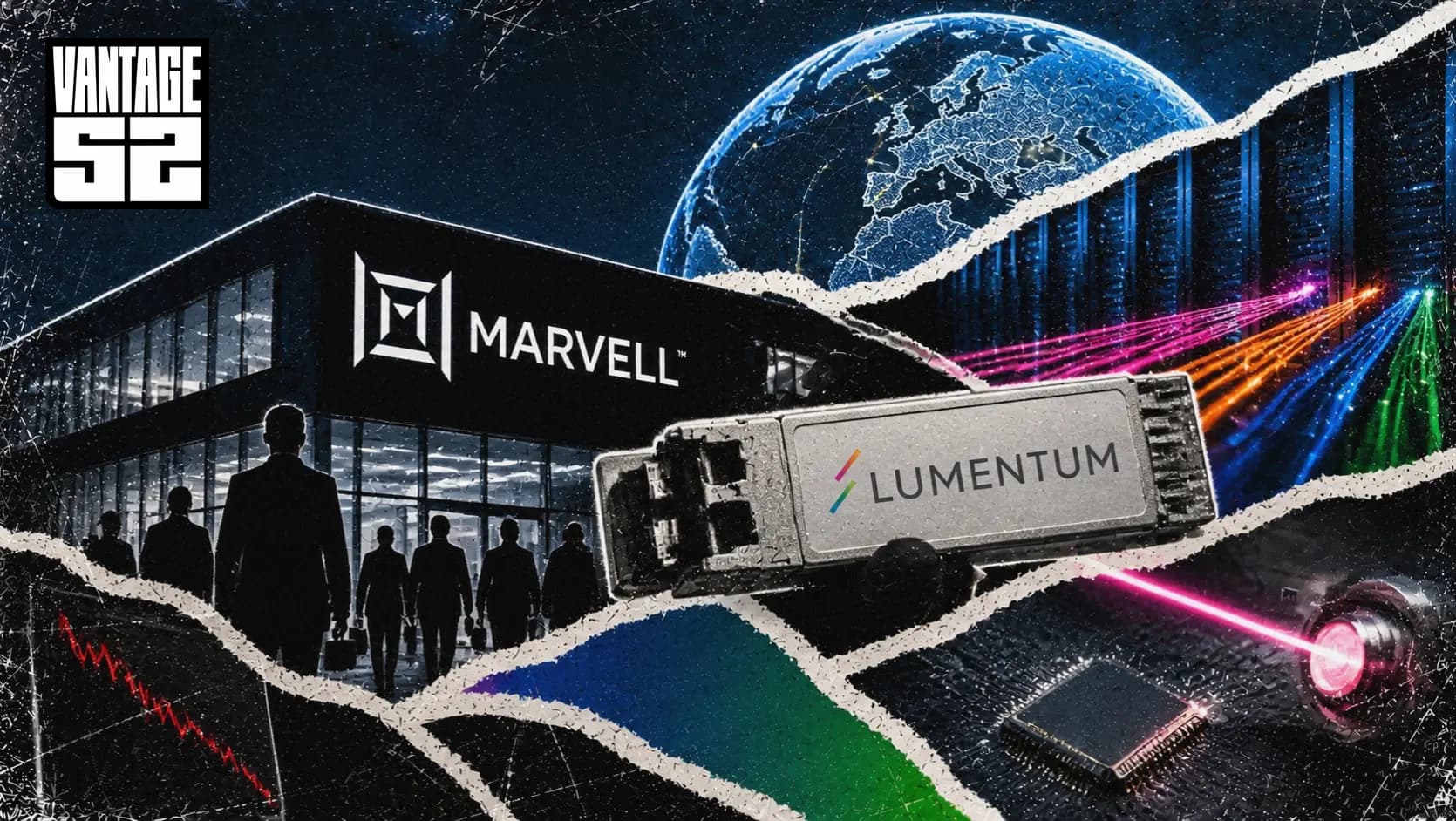
Marvell Technology has agreed to acquire Lumentum Holdings, a maker of lasers and optical components for data centres, in an all-stock transaction that the companies say implies an enterprise value of $115 billion for Lumentum. The deal was announced on 2 November, a day after the two companies signed the merger agreement.
Lumentum shareholders will receive a fixed 4.5 Marvell shares for each Lumentum share. Based on both companies’ unaffected closing prices on 28 October, the last trading day before market speculation about a deal, that equates to about $1,132 per Lumentum share and a premium of about 23.9%. Once the deal closes, current Marvell shareholders will own about 67% of the combined company and Lumentum shareholders about 33%.
Because the exchange ratio is fixed and no cash is involved, the value Lumentum shareholders receive moves with Marvell’s share price. Investors did not welcome the announcement. CNBC reported that Marvell’s shares fell 13% on the day and Lumentum’s nearly 19%, after both stocks had risen sharply over the past year.
Why Optics
The companies argue that artificial intelligence data centres are reaching the physical limits of copper wiring as the volume of data moving between chips and servers rises. Optical links, which carry data as light, offer more bandwidth over longer distances, and the companies expect them to move steadily closer to the processors themselves.
The deal combines Marvell’s electrical and optical interconnect chips, network switching and custom processors with Lumentum’s lasers, optical transceivers, optical circuit switches and compound semiconductor manufacturing, including indium phosphide. The aim, in the companies’ words, is extreme co-design of the electronics and the optics.
“AI infrastructure is undergoing a fundamental architectural shift toward optical connectivity, creating an opportunity that comes along once in a generation,” said Matt Murphy, Marvell’s chairman and chief executive. Michael Hurlston, Lumentum’s president and chief executive, said that joining Marvell “creates a company uniquely positioned to capitalize on a market opportunity of $550 billion and generate significant, sustainable stockholder value.”
Nvidia sits close to both companies. In March it announced a $2 billion investment in Lumentum and a multi-billion-dollar commitment to buy its advanced laser components. Murphy told CNBC the merger was “a double down on supporting Nvidia, who is the ecosystem leader in this area.”
The Financial Case
Marvell and Lumentum say they see a path to more than $1 billion in annual cost synergies, mostly in the cost of goods, and expect the deal to add to Marvell’s adjusted earnings per share in the first year after closing. They put the combined company’s addressable market at $550 billion.
Marvell’s investor presentation shows combined annualised revenue of about $17.7 billion on an adjusted basis, with roughly $12.6 billion from Marvell and $5.1 billion from Lumentum, based on their most recent quarters. Murphy will remain chairman and chief executive, and three Lumentum directors, including Hurlston, will join Marvell’s board.
A Long Road to Closing
The companies expect to complete the deal in the first half of 2028. It needs approval from both sets of shareholders, clearance under US antitrust law and other regulatory approvals that the filings do not name. According to the merger agreement filed with the Securities and Exchange Commission, Marvell would pay Lumentum a $3.2 billion termination fee if the deal fails on regulatory grounds.
Industry analysts were cautious. “This combination was completely unexpected for me,” Jimmy Yu of Dell’Oro Group told Fierce Network, questioning where the extra addressable market would come from. Roy Chua of AvidThink said the main attraction was vertical integration, but noted that Marvell also sells chips to optical module makers that compete with Lumentum, which could complicate those relationships.
What to Watch Next
The first test is the market itself. With a fixed share ratio, every move in Marvell’s stock changes the value of the offer, and a sustained fall could prompt questions from Lumentum shareholders before they vote.
Beyond that, regulators in several jurisdictions will examine a deal that would combine two important suppliers to the world’s largest AI customers. Customers will also watch closely, because the companies that buy Lumentum’s components today may compete with the combined group tomorrow.
Tags
Key Concepts
Sources
Where the reporting above comes from. Follow these to check the figures and statements for yourself.
- Marvell Technology and Lumentum via SEC, Marvell and Lumentum to Combine, Creating a Category Leader in AI Connectivity The joint announcement with the exchange ratio, implied value, premium, ownership split, synergies, timing, governance and chief executives’ quotes.
- Lumentum Holdings via SEC, Form 8-K, entry into a material definitive agreement The legal terms of the merger agreement, including closing conditions, outside dates and termination fees.
- Marvell Technology via SEC, Marvell and Lumentum to combine, investor presentation Pro forma revenue, margins and the composition of the expected synergies.
- Nvidia and Lumentum via SEC, NVIDIA Announces Strategic Partnership with Lumentum to Develop State-of-the-Art Optics Technology Nvidia’s $2 billion investment in Lumentum and its laser purchase commitment.
- CNBC, Lumentum CEO touts ‘enormous’ opportunity in massive AI connectivity deal with Marvell Independent report on the terms, the share price reaction and the Marvell chief executive’s comments on Nvidia.
- Fierce Network, Marvell buys Lumentum in $115B AI networking power play Analyst reaction from Dell’Oro Group and AvidThink and the competitive landscape.
- Yahoo Finance, Marvell to purchase Lumentum for $115 billion in record-breaking AI tech deal, both stocks tank Coverage of the market reaction and of how the fixed exchange ratio links the offer’s value to Marvell’s shares.