
Strikes on Saudi Arabia’s East-West Pipeline Test the IEA’s Oil Surplus Call
The IEA says oil is returning to surplus as Gulf exports recover. Saudi Arabia’s main route around Hormuz, a pipeline carrying about 4 million barrels a day, was struck on 9 November and faces new Houthi claims.
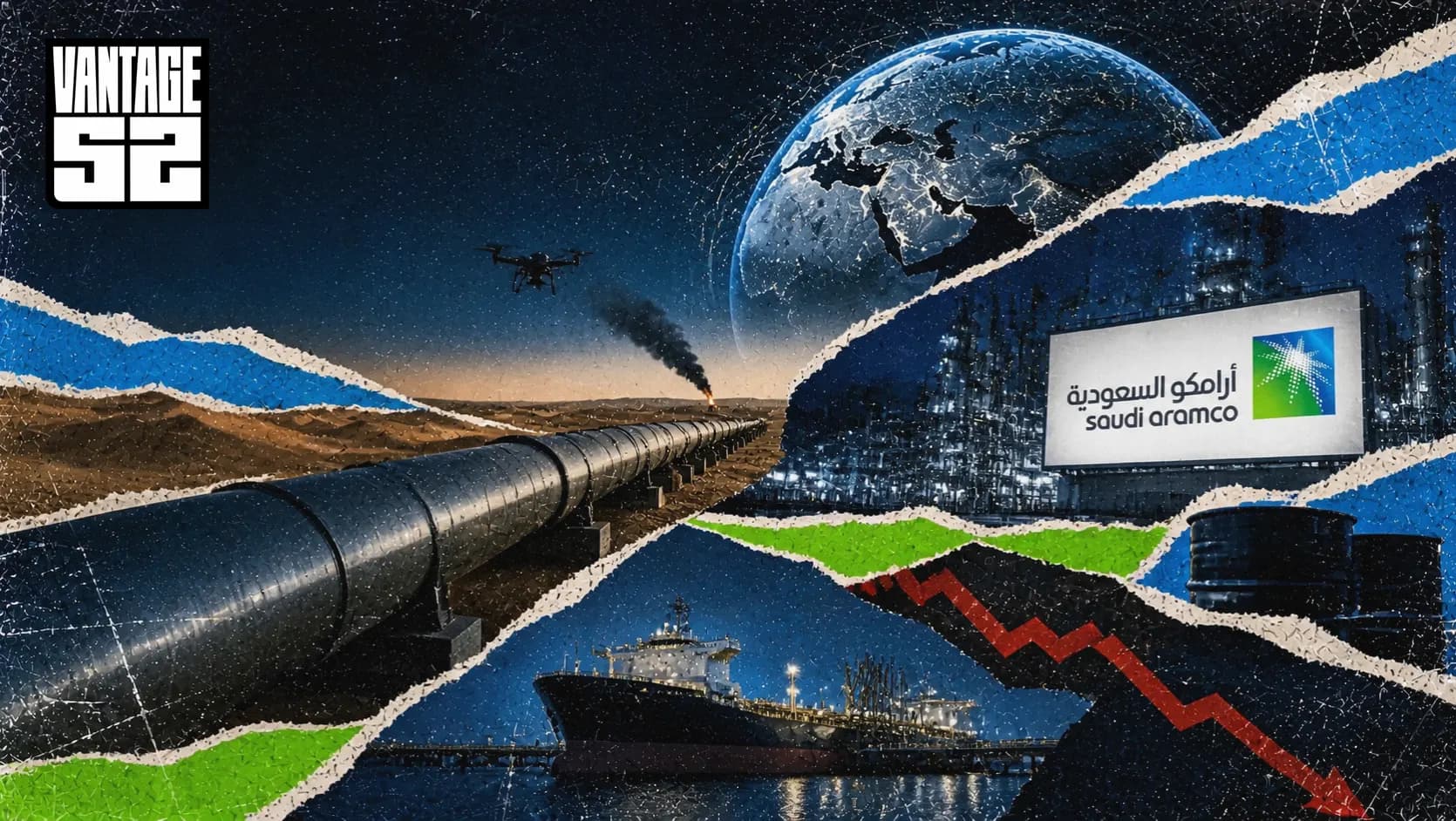
The International Energy Agency said on 13 November that the oil market is showing “tentative signs of rebalancing.” In its monthly Oil Market Report, it estimated that observed global stocks rose by 52 million barrels in October, or 1.7 million barrels a day, the first increase since June, as Gulf exports recovered.
A large share of that recovery runs through one line. On 9 November Saudi Arabia’s energy ministry said the East-West pipeline had been struck in the Medina region. A ministry official told the Saudi Press Agency the strike caused a limited fire that was put out, with no casualties, and that pipeline operations were unaffected. The ministry did not say who carried it out.
On 12 November Yemen’s Houthis claimed new attacks on a pumping station on the pipeline, an oil facility in Yanbu and an Aramco building in Riyadh. None of those claims has been independently confirmed. Reuters estimates that about 4 million barrels a day of crude is being rerouted through the pipeline to the Red Sea port of Yanbu, roughly 4% of global supply and more than twice October’s stock build.
What Riyadh Has Confirmed and What Is Only Claimed
The official record for the week is narrow. Beyond the 9 November statement, the spokesman for the Saudi-led coalition, Turki al-Maliki, said on 10 November that a ballistic missile and a cruise missile had been intercepted and destroyed over Riyadh and a second ballistic missile over the south of the country. He blamed the Iran-backed Houthis, Al Jazeera reported.
After the 12 November claims, the coalition said it had intercepted two drones launched by the group, one in the Riyadh region and one in the Eastern Province. There was no official word on whether these were the attacks the Houthis described. Saudi Arabia did not immediately respond to a Reuters request for comment, and no damage from the claimed strikes has been verified.
A 7 Million Barrel Line That Has Been Hit Before
The pipeline runs about 1,200 kilometres across the kingdom to Yanbu, letting Saudi crude reach the Red Sea without passing through the Strait of Hormuz. Aramco said in its first-quarter results on 10 May that it had ramped the line up to its maximum capacity of 7 million barrels a day. Amin Nasser, the chief executive, called it “a critical supply artery.”
It has been attacked before. On 11 September an energy ministry official told the Saudi Press Agency that “the pipeline was stopped as a precaution, and the attacks resulted in some injuries.” The foreign ministry said the drones had come from Iraq. Reuters later reported that the line was shut for several days.
Aramco’s third-quarter report, published on 3 November, acknowledged “some disruptions to the East-West Pipeline during the quarter” and said it had quickly restored loadings in the western region using the pipeline’s multiline configuration. Its supply reliability, the share of committed volumes delivered within 24 hours of schedule, fell to 97.8% in the quarter from 99.9% a year earlier. The company also disclosed that some of its facilities were targeted in attacks during the period and after it ended.
The IEA’s figures fit the same pattern. Saudi crude output was 8.93 million barrels a day in September, the month of the shutdown, and recovered to 9.99 million in October.
The Surplus the IEA Now Sees
Global supply rose by 2.3 million barrels a day to 105.4 million in October, the agency said. Gulf exports excluding Oman reached 18.4 million barrels a day, still 26% below pre-war levels, and Gulf crude exports rose to 15 million barrels a day, 82% of their pre-war level.
The IEA expects demand to fall by 2.7 million barrels a day this year to 102.3 million, then recover by 2 million barrels a day in 2027, while supply rises by 6.6 million barrels a day next year to 108.1 million. Reuters reported that this leaves a surplus of about 3.8 million barrels a day in 2027, even after the agency cut its 2027 supply growth forecast by 1.1 million barrels a day, partly because Iran’s exports are curbed by a US blockade.
Prices have moved first. North Sea Dated crude fell about 32%, from a high of $136 a barrel in early October to about $93, still $22 above pre-war levels, according to the IEA. Brent traded at about $96 on 13 November. Diesel in Europe remains about 77% above pre-war levels, and IEA members will make 71 million barrels of emergency stocks available by the end of February, including 15 million barrels of diesel, Reuters reported. The energy shock had already revived expectations of a Federal Reserve rate rise in September.
Why the Margin Is Thinner Than It Looks
Set the pipeline beside the balance and the cushion looks small. By VANTAGE52’s arithmetic from the figures above, the roughly 4 million barrels a day flowing to Yanbu is more than twice October’s stock build of 1.7 million barrels a day, larger than the 3.8 million barrel a day surplus projected for 2027, and equivalent to more than a quarter of the 15 million barrels a day of crude the Gulf exported in October.
The buffers behind the surplus are also thin. The IEA says on-land stocks are at their lowest since at least 2016, and observed global stocks have fallen by a cumulative 462 million barrels since the war began in late February. A market rebuilding from that position has less room to absorb an interruption than a headline surplus suggests.
VANTAGE52 noted in September, when the 10-year Treasury yield was approaching 5%, that Brent was trading near $100 a barrel amid disruption to Middle East energy infrastructure. So far the system has bent rather than broken. The IEA report does not mention the pipeline, but Saudi barrels loaded at Yanbu are part of the Gulf export recovery it describes, and each new attack or claim tests that recovery.
Iran’s Claims in the Strait
At sea, the claims are harder still to verify. Iran’s Revolutionary Guards navy said two supertankers were disabled by explosions on 11 November after ignoring warnings against using an “unauthorised route,” and Iran’s army said two more tankers hit mines on 12 November after entering a “restricted area.” Reuters could not verify either account.
One incident was independently logged. UK Maritime Trade Operations said a vessel leaving the strait was hit by an unidentified projectile about 14 nautical miles northwest of Ras Al-Khaimah on 11 November, causing an engine room fire, and that all crew had been evacuated. The Washington Institute counted at least 10 ships hit in the first 10 days of November, after 37 attacks in October, the highest monthly total since the war began, Reuters reported.
Gulf producers have kept exports moving partly through “dark crossings” of Hormuz, in which tankers switch off their tracking signals, according to Reuters. Iran’s claims are directed at ships using routes it says it has not authorised.
OPEC+ Ministers Meet on 29 November
The next decision falls to OPEC+. On 1 November Saudi Arabia, Russia, Iraq, Kuwait, Kazakhstan, Algeria and Oman kept their required production for December at September levels and set their next meeting for 29 November.
They will meet with two numbers pointing in different directions. One is a projected 2027 surplus of about 3.8 million barrels a day. The other is a bypass carrying about 4 million barrels a day of Saudi crude around Hormuz, which the Saudi government says was attacked in September and struck again on 9 November. The IEA’s December report will show whether October’s stock build held.
Tags
Key Concepts
Sources
Where the reporting above comes from. Follow these to check the figures and statements for yourself.
- International Energy Agency, Oil Market Report for November 2026 October supply, Gulf and Saudi exports and output, stock changes, demand and supply forecasts and Dated crude prices.
- Saudi Aramco, Third quarter 2026 interim report Disruptions to the East-West Pipeline, restored western loadings, supply reliability and attacks on company facilities.
- Saudi Aramco, First quarter 2026 results The East-West Pipeline’s maximum capacity of 7 million barrels a day and Amin Nasser’s comment.
- OPEC, Seven OPEC+ countries reaffirm commitment to market stability December production decision and the next meeting on 29 November.
- Reuters via bdnews24, Saudi East-West pipeline struck in Medina region The energy ministry source on the 9 November strike, the 4 million barrels a day rerouted to Yanbu and the September shutdown.
- Al Jazeera, Saudi Arabia downs missiles fired at Riyadh after Houthi attack on pipeline The ministry’s account of the 9 November strike via SPA and the coalition’s interceptions on 10 November.
- Al Jazeera, Saudi Arabia says East-West pipeline hit by drones launched from Iraq The precautionary shutdown in September and the foreign ministry’s attribution to drones from Iraq.
- Reuters via bdnews24, Yemen’s Houthis say they attacked pumping station on Saudi Arabia’s East-West oil pipeline The Houthi claims of 12 November and the coalition’s drone interceptions.
- Reuters via GV Wire, Four tankers struck by explosions in Strait of Hormuz, Iran says Iranian claims of tanker strikes, the UKMTO incident off Ras Al-Khaimah and the Washington Institute’s attack count.
- Reuters via Arab News, IEA says oil market returning to surplus as Gulf exports recover The 2027 surplus estimate, the supply forecast cut, emergency stock releases, dark crossings and the Brent price.