
MariaDB’s Rebrand Recasts an Open Source Database as a Platform for AI Agents
The database company redrew its sea lion and launched Enterprise Platform 2027 on 4 November. Private since K1 bought it in 2024, it is chasing the agent workloads that Oracle, Databricks and Snowflake also want.
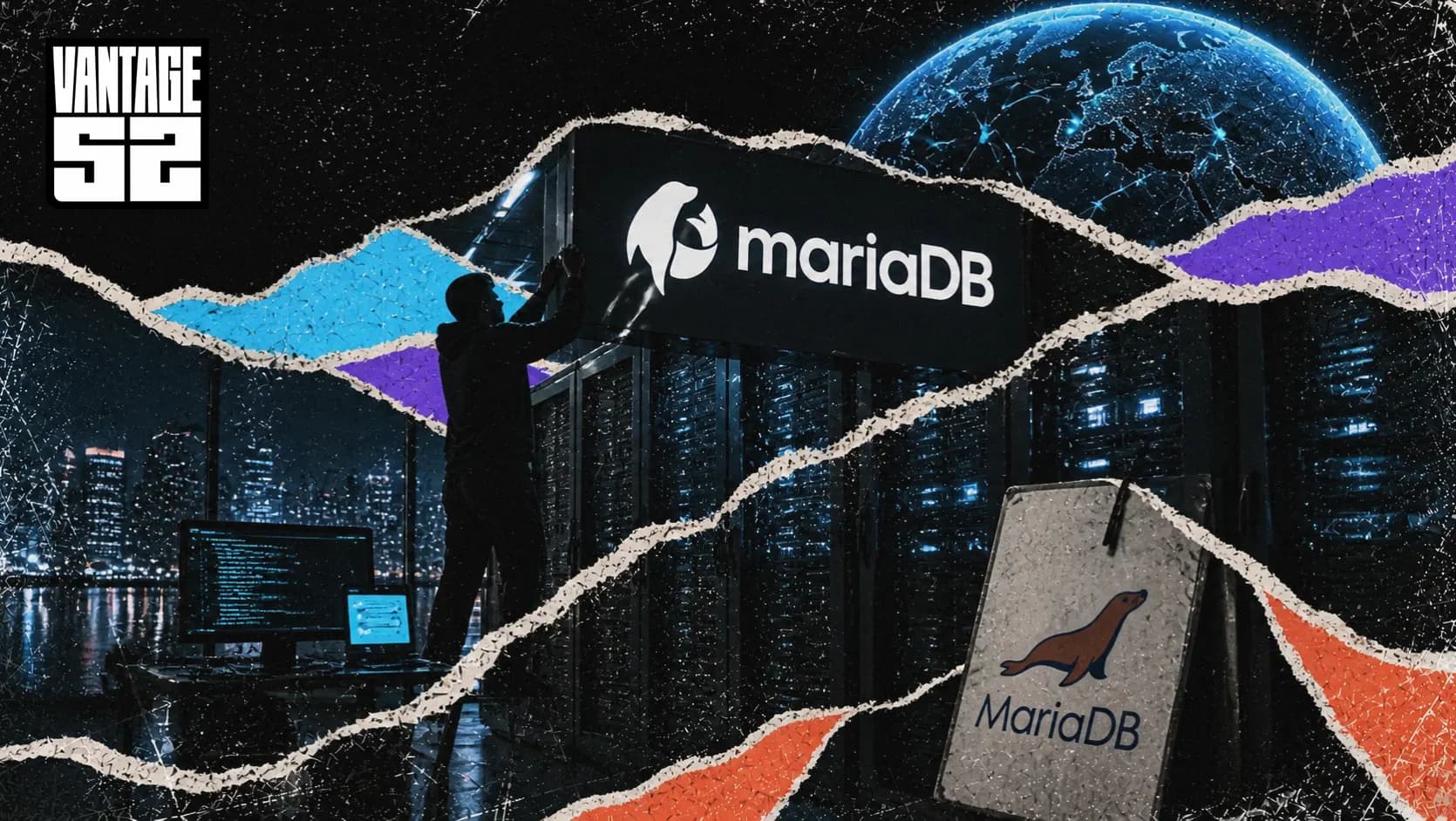
MariaDB plc unveiled a new brand identity on 4 November, combining a redesigned logo, a heavier visual system and what it calls a vivid new colour palette. The identity went live the same day on a redesigned mariadb.com and in the company’s media kit. No design agency has been named.
The sea lion survives the change. In the new logo files it is a solid silhouette, head raised, set against a circle and supplied only in black or white, beside a wordmark that now reads “mariaDB” in a heavier, rounded typeface. The old logo showed a copper sea lion in profile next to a navy “MariaDB”. The colour lives on the website instead, whose stylesheet defines families named Coral, Kelp, Current, Beacon, Flare and Ultraviolet around a near-black called Ink, with cyan, violet and coral the most visible on its pages.
The description changed as well. The company now calls itself “the Unified Open Database Platform for the Agentic Enterprise”. In October 2025 it was “the company behind the cloud database platform for GenAI”. “A brand should tell you what a company believes before you read a word, and ours was telling an old story,” said Tracy Strauss, MariaDB’s chief marketing officer.
The identity shipped with a product, and the two are meant to be read together. Enterprise Platform 2027, generally available from the same day, is what MariaDB now wants buyers to think of when they see the sea lion.
What Enterprise Platform 2027 Puts Behind the Logo
The release combines MariaDB Enterprise Server 12.3 with MariaDB Exa for analytics, MariaDB GridGain for in-memory processing, the MaxScale proxy, Enterprise Manager and a Kubernetes Operator. It runs on a customer’s own servers, in any cloud or as a managed service on MariaDB Cloud.
The agent features are the new part. Agent Memory gives software agents a shared in-memory store that persists between sessions. Semantic Cache returns a stored answer when a question has already been asked in different words, which MariaDB says cuts response times and token costs. AI Retrieval turns natural-language questions into read-only SQL and is due in public preview on MariaDB Cloud later in November. Plugins feed MariaDB know-how into coding agents such as Claude Code and Codex.
MariaDB also claims 56% higher peak throughput than its previous major release. The figure comes from a test by McKnight Consulting Group that MariaDB sponsored, using a benchmark derived from TPC-C that the company’s own footnote says is not an official TPC-C result. Vector search, it says, now handles up to 30% more queries per second.
Several of the parts were bought or borrowed. Exa runs on the analytics engine of Exasol, of Nuremberg, under a partnership announced on 22 October 2025. GridGain, creator of the open source Apache Ignite in-memory platform, was acquired in a deal agreed on 9 March 2026 and completed on 24 March, with terms disclosed in neither announcement. “For the last 18 months, we have been building MariaDB for the agentic era,” Rohit de Souza, the chief executive, said when the purchase closed.
From the New York Stock Exchange to a Private Equity Portfolio
The company doing the rebranding is not the one that existed three years ago. MariaDB began as a fork of MySQL, created over concerns about that database’s independence once Oracle came to control it, and its corporate arm listed in New York through a special purpose acquisition company in late 2022. TechCrunch reported that its valuation peaked at $445 million on the first day of trading and fell below $12 million by the start of 2024, after the exchange had warned it about its market value.
K1 Investment Management, a California firm that describes itself as one of the largest investors in small-cap enterprise software companies, announced the completion of its takeover on 10 September 2024. It paid $0.55 a share, which TechCrunch put at about $37 million for the company. The same day MariaDB named de Souza, previously an executive at Actian and Micro Focus, as chief executive.
As a private company MariaDB no longer publishes revenue. At the time of the buyout it reported nearly 700 active customers. The new release speaks instead of thousands of enterprises and millions of developers, a wider measure it does not break down, and names Deutsche Bank, DBS, Nokia, Red Hat, Samsung and Virgin Media O2 among them.
Thirteenth Place in a Market Led by Oracle and Postgres
On the DB-Engines ranking for November 2026, MariaDB is 13th of 442 database systems with a score of 75.07, down 12.29 points from a year earlier. Oracle, MySQL, Microsoft SQL Server and PostgreSQL hold the first four places, and PostgreSQL is the only one of the four whose score rose over the year. Snowflake is sixth and Databricks seventh.
The ranking measures popularity, from web mentions, search interest, job listings and professional profiles, not installations or sales. It still points to the problem the rebrand addresses. Attention is moving towards PostgreSQL and the large data platforms, and a system in 13th place with a falling score needs a reason for buyers to look again.
Every Database Vendor Is Now Selling to Agents
MariaDB is not alone in rewriting its pitch. Oracle renamed its flagship product Oracle AI Database 26ai on 14 October 2025, replacing Oracle Database 23ai, and promised tools for building agents that run inside the database. Databricks agreed in May 2025 to buy Neon, a serverless Postgres company, saying its internal telemetry showed that more than 80% of databases provisioned on Neon had been created by AI agents rather than people. In June 2025 Snowflake announced a plan to buy Crunchy Data to build Snowflake Postgres for agent and application developers, a deal TechCrunch valued at about $250 million, citing a person familiar with the matter.
The routes differ, and MariaDB’s release says so. “Analytics-first vendors are working backward toward transactions, the hardest workload to get right,” it states, a description that fits Databricks and Snowflake, though neither is named. MariaDB starts from the other end, a transactional database already running banking and telecoms systems, and adds analytics through Exasol and in-memory speed through GridGain. Both routes arrive at the same claim, that one platform can feed an agent live data without the copies and pipelines in between.
It is a version of the move n8n made when it redrew its identity around AI orchestration in October, a company built for one job presenting itself as infrastructure for agents. MariaDB cites IDC forecasts that agent use at the world’s 2,000 largest companies will rise tenfold by 2027, as model makers such as OpenAI pitch systems that carry out multi-step professional work end to end.
The Webinar on 18 November and the Preview After It
The rebrand has one complication that most corporate redesigns do not. MariaDB plc sells the enterprise platform, but the open source project of the same name is governed by the MariaDB Foundation, a non-profit. The Foundation’s website already shows the redrawn sea lion, in copper, beside the new wordmark, so the two organisations now share one look. The release does not mention the Foundation or say who decided that, which leaves a community project’s identity tied to a company’s pitch for agents.
The larger question is evidence. The throughput figure comes from a sponsored test, the agent features are days old and AI Retrieval has yet to reach public preview. MariaDB will demonstrate the platform in a webinar on 18 November, and the preview on MariaDB Cloud is due before the month ends. Customers naming agent workloads they run on MariaDB rather than on Postgres or a data platform would show that the new identity describes the business, not only the ambition of its owner.
Tags
Key Concepts
Sources
Where the reporting above comes from. Follow these to check the figures and statements for yourself.
- MariaDB, MariaDB launches into the agentic era with an agent-ready platform and a bold new brand The new identity, the Enterprise Platform 2027 components and agent features, the sponsored benchmark footnote, the IDC forecasts cited and the executives’ comments.
- MariaDB, Official MariaDB logos and usage guidelines The media kit with the new 2026 logo files in black and white, vertical and horizontal.
- MariaDB, K1 acquires a leading database software company, MariaDB, and appoints new CEO Completion of K1’s tender offer, Rohit de Souza’s appointment and the nearly 700 active customers reported at the time.
- TechCrunch, MariaDB goes private with new CEO as K1 closes acquisition The 2022 SPAC listing, the fall in valuation, the NYSE warning and the $0.55 a share price.
- MariaDB, MariaDB completes GridGain acquisition to power the next generation of agentic AI Completion of the GridGain purchase and the chief executive’s comment on 18 months of building for agents.
- MariaDB, MariaDB and Exasol announce strategic partnership to bring unified high performance analytics The partnership behind MariaDB Exa and the company’s earlier description of itself.
- DB-Engines, DB-Engines Ranking, November 2026 Popularity ranking of 442 database systems, with year-on-year score changes. The method is set out at db-engines.com/en/ranking_definition.
- Oracle, Oracle AI Database 26ai powers the AI for data revolution The renaming of Oracle’s database and its in-database agent tools.
- Databricks, Databricks agrees to acquire Neon to deliver serverless Postgres for developers and AI agents The Neon deal and the telemetry on databases created by AI agents.
- TechCrunch, Snowflake to acquire database startup Crunchy Data Snowflake’s plan for Snowflake Postgres and the reported value of the deal.