
Mirakl’s Rebrand Turns Its Brand Guidelines Into Rules AI Agents Can Follow
The marketplace software company dropped its capital letters and flattened its logomark on 9 November. It also converted its guidelines into machine-readable rules for Claude, Dust and Figma, and makes its imagery with Gemini.
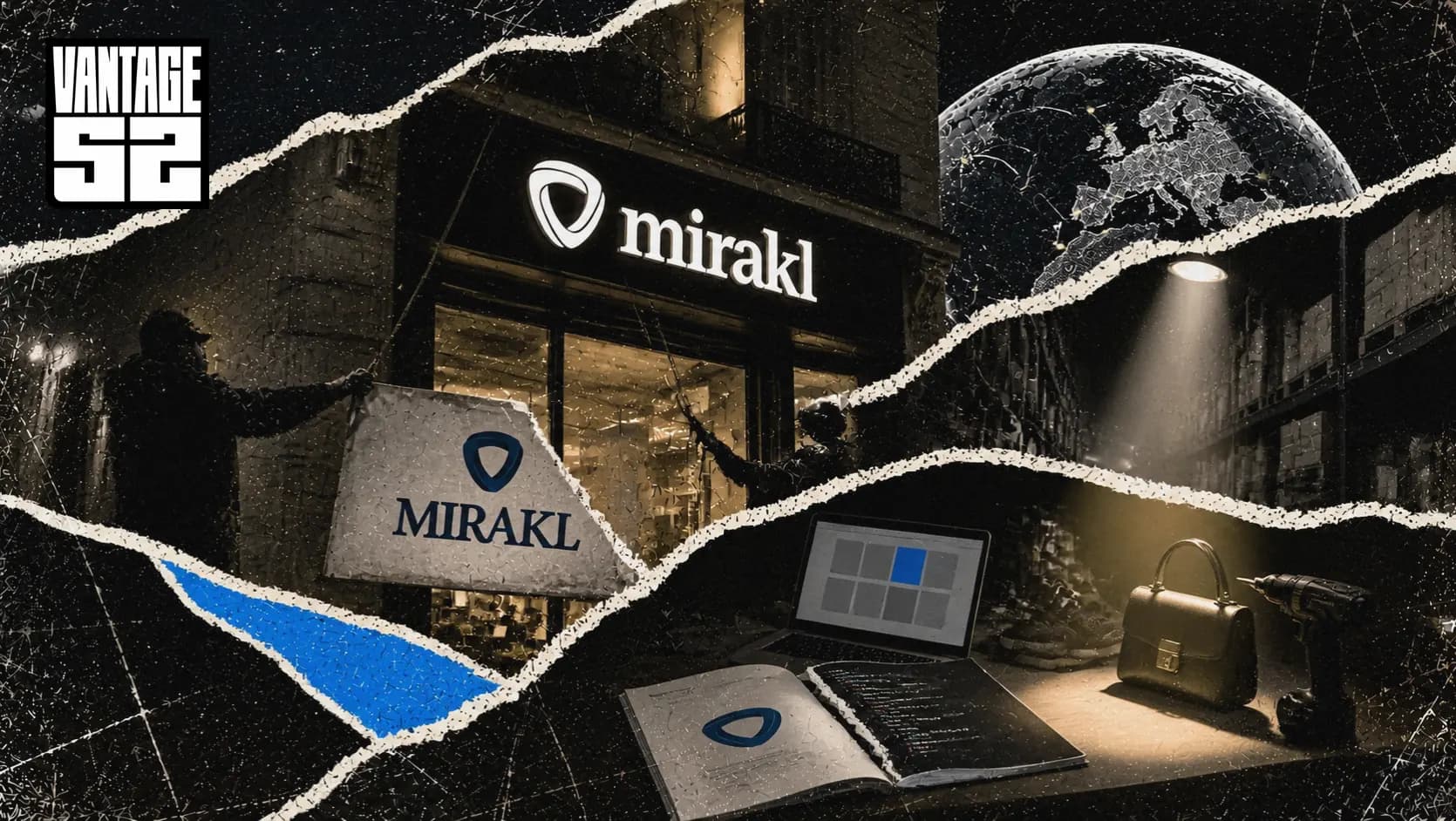
Mirakl’s name is now written in lowercase. On 9 November the marketplace software company, which has headquarters in Paris and Boston, replaced its uppercase serif wordmark with a lowercase serif one and turned its shaded, three-dimensional logomark into a flat symbol. The identity was created by Koto, which Mirakl describes as a global creative company, with creative direction from Sam Howard and Brya Taylor, and it is already in use on Mirakl’s website.
The palette has been cut back to two neutrals, Cloud white and Obsidian black, plus a cobalt accent called Mirakl blue that is kept for calls to action and the single number that matters most on a page. Headlines are set in Oceanic Text and everything else in Inter. Five products, Mirakl Platform, Connect, Ads, Payout and Catalog Platform, now share one sub-logo system, under the positioning line “Mirakl is the Operating System for intelligent commerce.”
What sets the project apart is a passage in the account by Darius Meadon, Mirakl’s chief marketing officer. The company’s brand guidelines, he writes, “go far beyond a traditional PDF”. Mirakl has “translated our design language into machine-readable rules, embedded directly into Claude and Dust agents and connected to real design components in Figma.”
What Koto Kept and What It Redrew
Meadon calls the work “an evolution, not a revolution”, and the logo shows how that was applied. The logomark carried most of the recognition, so it was refined rather than replaced. It is now flat, to stay legible at any size from a browser tab icon to a billboard, though a three-dimensional version returns against the gradient for big moments such as the end of a film.
The wordmark was redrawn from scratch. The serif stayed because Mirakl associates it with authority, and so did the link between the “r” and the “a”, except that the two letters now run in parallel lines where they used to join.
The rest of the system follows from that restraint. A layout structure Mirakl calls the Intelligent Grid arranges images and type into bento-style blocks. A shifting blue gradient is meant to make the colour more ownable, in Meadon’s word, and a blue square serves as punctuation in copy and motion. Photography follows a style named Le Rayonnement, a French word for radiance, built on close crops of the products Mirakl’s customers sell.
A Style Guide Written for Software
Brand guidelines have traditionally been written for people, the designers and agencies who read the rules and interpret them. Mirakl says it has also written its rules for software. Claude is Anthropic’s AI model, Dust is a platform on which companies build agents connected to their own knowledge and tools, and Figma is the design software where Mirakl keeps its components. According to Meadon, the company’s agents no longer interpret the brand from scratch but build from a shared system, which keeps output consistent across teams, tools and workflows.
The imagery goes further. The Le Rayonnement effect is produced “with a custom AI prompt”, Meadon writes, and Mirakl uses Gemini, Google’s model, with engineered prompts to generate pictures with consistent lighting, colour and character for its website, paid media, reports and campaigns. Its next aim, he adds, is to connect the design agents to content creation and demand generation, “moving towards fully autonomous, zero-touch campaign production.”
The distinction worth drawing is about which agents these are. They are not the shopping assistants that Mirakl’s products are built to serve, the software that may one day read a retailer’s catalogue and buy on a customer’s behalf. The machine-readable brand is an internal production system for Mirakl’s own marketing. Mirakl has not published the rules, said what format they take, said whether Koto or its own team encoded them, or given any figure for how much of its material is now generated.
Ownable Imagery and the Limits of Copyright
Meadon describes the prompt-made photography as “distinctive, ownable imagery at scale”. Ownable in the branding sense means recognisable as Mirakl. The legal sense is narrower. In January 2025 the US Copyright Office concluded that generative AI output can be protected by copyright only where a human author has determined sufficient expressive elements, which can include creative arrangement or modification of the output, “but not the mere provision of prompts.”
That does not stop Mirakl using the images, and the Office’s view covers US law only. It does mean that the amount of human selection and editing in each picture decides how far Mirakl could prevent others from copying it there, a question for any company moving campaign work to models. Mirakl has not described its review process, or where people sit in the zero-touch production it is aiming for.
The Business Behind “Intelligent Commerce”
The positioning came before the logo. In a release on 11 December 2025 Mirakl still called itself “the leading provider of eCommerce and marketplace software solutions”. By 26 February 2026, when it reported its 2025 results, it was “the Operating System for Intelligent Commerce”. Meadon says the second phrase was chosen as one the company can own, adding, “I expect it to outlast ‘agentic commerce’.”
Those results describe the company the new identity has to carry. Mirakl counts more than 450 customers, among them Macy’s, Decathlon, Carrefour and Asos. It says annual recurring revenue rose 23% to $218 million in 2025 and that the group was profitable for the full year. Gross merchandise value through Mirakl Platform reached a record $14.6 billion, up 31%, and Mirakl Connect, a tool for brands selling across several marketplaces, reached $11.7 million in recurring revenue in under a year. Its last disclosed valuation was more than $3.5 billion, set when it raised $555 million in a round led by Silver Lake in September 2021.
The new line points at agentic commerce. With those results Mirakl presented Nexus, which it calls its “Agentic Commerce Brain”, a layer meant to make merchants’ catalogues readable by AI platforms and let them sell through those channels. It signed a partnership with Stripe in December 2025 and another with J.P. Morgan Payments in March 2026, then in closed beta with selected retailers and planned for wider availability during 2026. The terms on which shops admit buying agents are still being set, as OpenAI’s new wallet, which lets its agents pay only where retailers allow them in, shows.
The launch leaves a gap. The sub-logo system covers five products, and Nexus, which the company description in the same release lists as Mirakl’s agentic commerce infrastructure, is not among them. Martech Edge, a trade publication, observed that the announcement “does not detail specific agentic commerce deployments or new AI product launches.”
Where the New Identity Will Be Judged
Commerce brands are redesigning with automated buying in mind. Visa’s October identity refresh was built to stay recognisable on small screens and in AI-powered shopping. Mirakl’s version faces two audiences at once, the merchants and platforms behind that checkout, and its own marketing team.
The first test is commercial. The J.P. Morgan Payments service was due to open more widely in 2026, and a named retailer selling through AI channels on Nexus would show the positioning is more than a line. The second test is Mirakl’s claim about itself. A campaign produced end to end by agents working from encoded rules would show whether a brand can be run as software. Until Mirakl shows one, the machine-readable brand is a stated method, not a measured result.
Tags
Key Concepts
Sources
Where the reporting above comes from. Follow these to check the figures and statements for yourself.
- Mirakl, Mirakl unveils new brand identity and positioning to power the transformation of retailers, brands and B2B companies The launch date, the positioning line, the identity elements, Koto’s role and creative direction, and the company description.
- Mirakl, The Mirakl brand refresh, evolving our brand as we transform commerce (Darius Meadon) The chief marketing officer’s account of the logo, type, colours and imagery, and of the machine-readable brand rules used with Claude, Dust, Figma and Gemini.
- Mirakl, Mirakl reached $218M ARR (+23%) and launched agentic commerce platform (Mirakl Nexus) 2025 recurring revenue, profitability, gross merchandise value, Mirakl Connect and the presentation of Mirakl Nexus.
- Mirakl, Mirakl and Stripe partner to power agentic commerce The Stripe partnership and Mirakl’s description of itself before the new positioning.
- Mirakl, Mirakl and J.P. Morgan Payments to power agentic commerce at enterprise scale How Nexus is meant to work with J.P. Morgan Payments, the closed beta and planned availability in 2026.
- Mirakl, Mirakl announces $555 million Series E funding The round led by Silver Lake and the valuation of more than $3.5 billion.
- W&V, Wie Mirakl seine gewachsene Produktwelt unter einer Marke vereint German marketing trade report on the launch, with comments from Darius Meadon (subscription required for the full text).
- Martech Edge, Mirakl’s intelligent commerce platform strategy Trade analysis of the repositioning and its observation that no agentic commerce deployments were detailed.
- US Copyright Office, Copyright Office releases Part 2 of Artificial Intelligence Report The Office’s conclusion on when generative AI output can be protected by copyright.