

Trump Wants to Call AI Super Intelligence and the Definition Matters
Donald Trump used the United Nations General Assembly to introduce a new name for artificial intelligence. Behind the language is a much larger debate over what superintelligence actually means, who should regulate advanced AI and how the United States intends to compete for technological leadership.
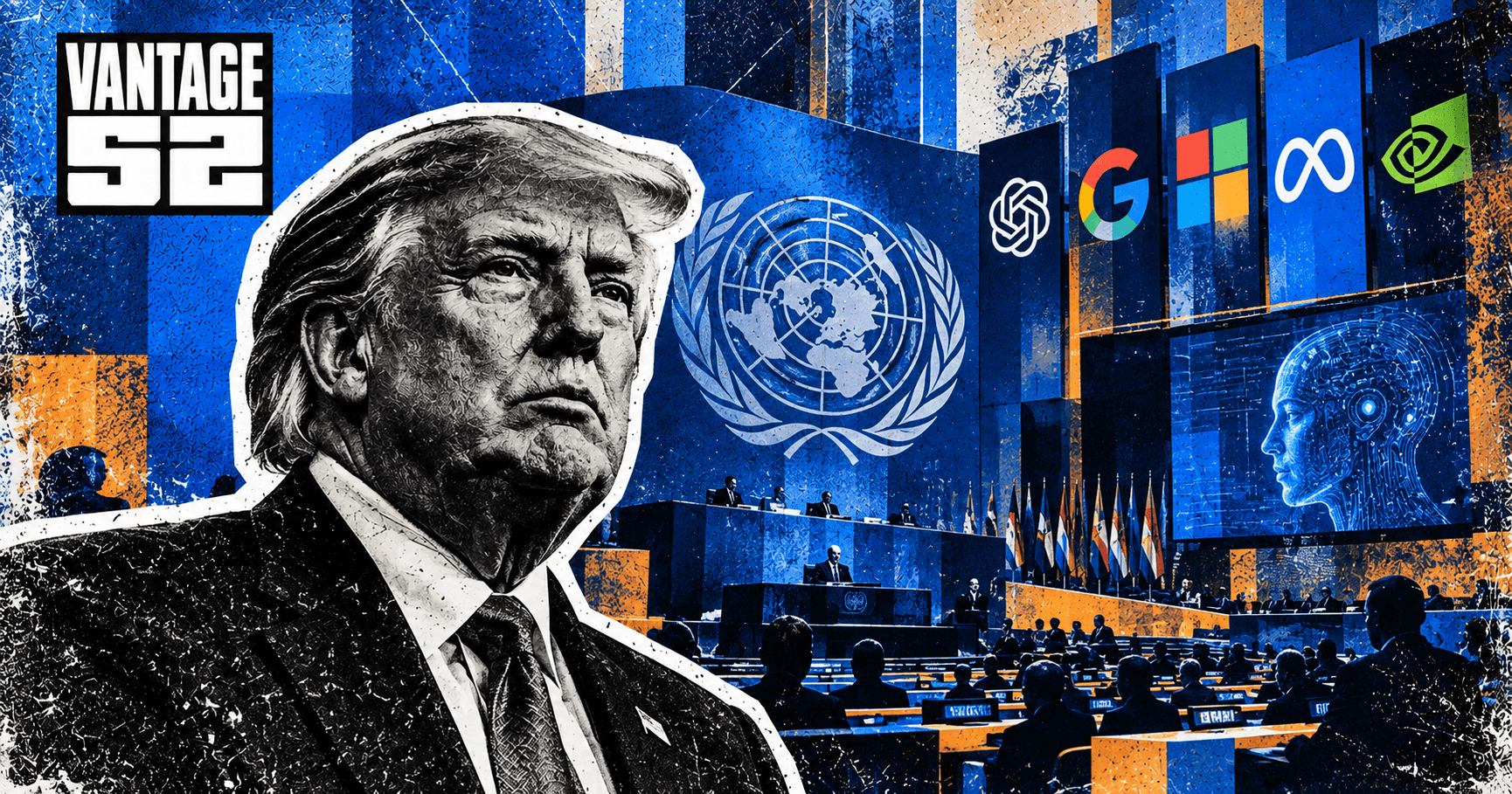
Artificial intelligence acquired an unexpected new name at the United Nations this week.
During his address to the 81st United Nations General Assembly in New York on September 22, U.S. President Donald Trump said the United States would begin referring to artificial intelligence as “super intelligence,” arguing that the word “artificial” makes the technology sound less real than it is.
“From this point forward, all of United States documents and hopefully the world will be changed to use the much more accurate term ‘super’ as opposed to ‘artificial,’” Trump told world leaders.
He then introduced the abbreviation “SI” and framed the technology as one of the defining competitive arenas of the coming decades.
The terminology may sound like branding, but it intersects with a much more consequential debate. Superintelligence already has a specific meaning within artificial intelligence research, and it does not simply mean AI with a different name.
Superintelligence Already Means Something
In AI research, artificial intelligence is an umbrella term covering a broad range of systems capable of performing tasks associated with human intelligence. Today's generative models, recommendation systems, computer-vision technologies and autonomous agents all fall within that broad category.
Superintelligence is different.
The term is generally used to describe a hypothetical level of artificial intelligence that substantially exceeds human cognitive capabilities across virtually all important domains. Google DeepMind researchers have described artificial superintelligence as artificial general intelligence with superhuman capabilities across essentially all tasks and domains of human interest.
That distinction matters because today's leading AI models are not generally considered superintelligent. They can outperform humans in certain areas while remaining inconsistent or limited in others.
Trump's use of the term therefore represents a political redefinition rather than a change in the technical capabilities of existing AI systems.
The distinction has already attracted attention outside the White House. PolitiFact noted that industry definitions of superintelligence describe capabilities considerably beyond those available in current AI systems, while several major AI models have reportedly maintained the distinction between present-day AI and the established meaning of superintelligence.
Trump Is Framing AI as a Global Race
The language was accompanied by a broader argument about technological competition.
Trump told the General Assembly that the United States intends to maintain its position in advanced AI and specifically framed China as its principal competitor. His message was that technological leadership should be accelerated rather than constrained by international governance.
“Whoever wins superintelligence wins,” Trump said.
He also described the technology as potentially larger in significance than the Industrial Revolution or the internet and said he did not intend to suppress its development.
The statement places AI alongside semiconductors, energy infrastructure and other technologies that governments increasingly view through the lens of economic and national power.
The competition is no longer limited to which company produces the strongest model. Access to computing infrastructure, semiconductor supply chains, energy, data centers, research talent and capital are becoming strategic assets in a broader contest over who controls the infrastructure behind advanced intelligence.
Changing the language from AI to super intelligence does not alter those fundamentals, but it reveals how Washington increasingly wants to frame the technology.
The United States Is Resisting Global AI Governance
Trump's remarks also contained a policy message that may prove more important than the terminology itself.
The president rejected international attempts to establish a global system for regulating artificial intelligence, arguing instead for continued U.S. development with domestic oversight. He said the Department of Justice and other law-enforcement institutions could intervene if necessary while emphasizing that his administration would primarily encourage technological development.
That position became clearer a day later when White House Office of Science and Technology Policy Director Michael Kratsios told the UN Security Council that international discussions should not evolve into a system of global AI governance. The administration's preference is for countries to develop their own regulatory frameworks while cooperating internationally without transferring authority to a global regulatory structure.
This creates a fundamental disagreement over how advanced AI should be governed.
UN Secretary-General António Guterres used the same General Assembly to call for stronger safeguards, particularly around autonomous weapons and systems capable of making decisions with potentially irreversible consequences. Other leaders also emphasized international standards and cooperation.
The result was an unusually visible contrast between two approaches to the next stage of AI development.
One prioritizes rapid technological development, national sovereignty and competition. The other places greater emphasis on international coordination and safeguards as AI systems become more capable.
Language Could Become Technology Policy
The attempt to rename AI may initially appear symbolic, but governments use terminology to define policy priorities.
The Associated Press reported that the U.S. State Department subsequently instructed diplomats working on international organizations to use “super intelligence” instead of “artificial intelligence” in communications following Trump's UN remarks.
If the terminology spreads across federal agencies, strategy documents and diplomatic communications, it could gradually become part of the language Washington uses when discussing advanced AI internationally.
That would create an unusual situation because the U.S. government's use of “super intelligence” would differ from the established technical definition used by many researchers.
The distinction could become particularly important when discussing AI safety. A policy document referring to existing models as superintelligence would be using the same word that researchers often reserve for a hypothetical system far beyond current capabilities.
For companies, researchers and regulators, clarity around those definitions matters because different levels of AI capability create very different economic, security and governance questions.
AI Is Becoming a Geopolitical Asset
Trump's remarks also demonstrate how far artificial intelligence has moved from the technology industry into international politics.
AI is increasingly discussed alongside energy security, defense capabilities, trade and industrial policy. Governments are competing for semiconductor capacity, building domestic data-center infrastructure and attempting to secure access to the electricity required to operate increasingly powerful models.
The companies developing those systems are consequently becoming strategically important actors.
OpenAI, Anthropic, Google DeepMind, Meta and other AI developers are building technologies whose economic importance increasingly intersects with national policy. At the same time, Chinese companies and research institutions continue to advance their own models and infrastructure.
The competition Trump described at the United Nations is therefore much larger than a race between individual AI products. It involves the industrial infrastructure required to develop and deploy increasingly capable systems at scale.
The Debate Over Superintelligence Has Arrived Early
There is another reason Trump's choice of language matters.
For years, superintelligence was largely discussed as a future possibility within AI research, philosophy and long-term technology forecasting. The term referred to a potential stage beyond artificial general intelligence, when machines could outperform humans across almost every meaningful cognitive domain.
Trump has now brought that vocabulary directly into presidential politics and international diplomacy, but with a different definition.
Whether the new terminology becomes widely adopted remains uncertain. World leaders speaking after Trump largely continued using the established term “artificial intelligence,” and the technical distinction between AI and superintelligence remains significant.
What is already clear is that the language surrounding AI is becoming part of the geopolitical competition surrounding the technology itself.
The debate at the United Nations was therefore about more than a name. It exposed competing ideas about what advanced AI represents, how quickly it should develop, who should establish its rules and which countries will control the infrastructure behind it.
Trump may want Washington to call the technology super intelligence. The more consequential question for the global technology industry is how close AI eventually comes to making that description technically accurate.
Tags
Key Concepts
Sources
Where the reporting above comes from. Follow these to check the figures and statements for yourself.
- The American Presidency Project - Remarks to the United Nations General Assembly in New York City
- Reuters - Trump says US Justice Department could rein in AI companies if needed
- The Washington Post - Trump says he’s renaming AI to ‘super intelligence’
- Scientific American - Trump rejects AI regulation, citing parallels with climate change in UN address
- PolitiFact - President Donald Trump misleads on Iran war, AI in speech to UN
- Euronews - Leaders push for stronger AI safeguards at UN as Trump touts ‘Super Intelligence’